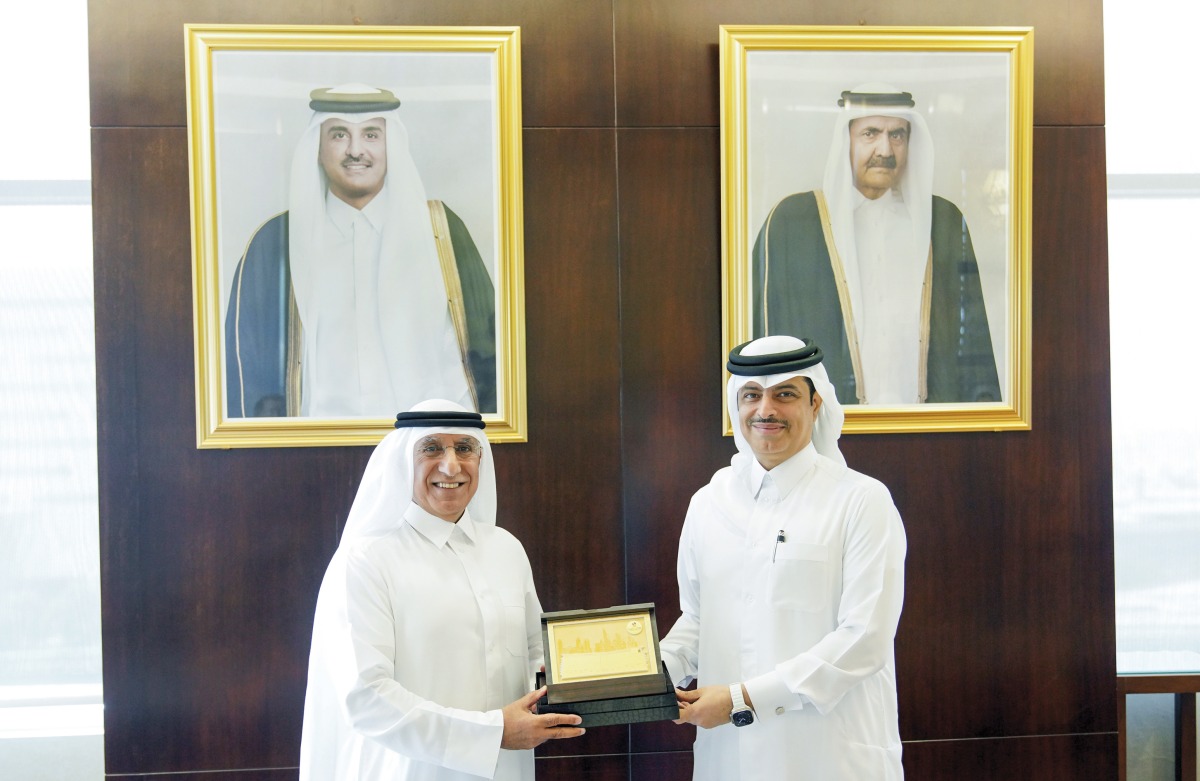
Director of the Non-Communicable Disease Prevention Programmes Department Sheikh Dr. Mohamed bin Hamad Al Thani and UDST President Dr. Salem bin Nasser Al Naemi at the signing ceremony.
DOHA: The Ministry of Public Health (MoPH) has signed a Memorandum of Understanding (MoU) with the University of Doha for Science and Technology (UDST) to establish a framework for cooperation in research, education and community services.
The MoU was signed on behalf of MoPH by Sheikh Dr Mohamed bin Hamad Al-Thani, Director of the Non-Communicable Disease Prevention Programmes Department, and on behalf of UDST by its President, Dr Salem bin Nasser Al Naemi.
The MoU forms part of efforts to strengthen coordination and cooperation between MoPH and UDST in providing educational opportunities for students from the University’s various colleges; designing and developing postgraduate degree programmes and academic pathways; providing practical training and teaching opportunities for University students at MoPH and its affiliated institutions; supporting students’ graduation projects in health-related fields; and designing and implementing continuing education programmes in business administration, health sciences, engineering and technology, and computing and information technology, based on the needs of both parties.
Sheikh Dr Mohamed bin Hamad Al Thani said, “The MoU between MoPH and UDST represents a significant step towards strengthening the national partnership between the health sector and academic institutions. It also provides an organised framework for cooperation in education, training, capacity-building, scientific research and community service in a way that supports MoPH’s priorities and contributes to the development of national capabilities.
“Through this partnership, we look forward to benefiting from the expertise and capabilities of both parties, providing high-quality opportunities for students and staff, and strengthening applied research linked to national health needs and priorities.
“We also look forward to developing joint initiatives that contribute to promoting community health and achieving the objectives of Qatar’s health sector.”
UDST President Dr. Salem bin Nasser Al Naemi said, “The MoU we are signing today is the product of years of collaboration with MoPH—a partnership of which we are proud and which has spanned various areas, particularly education and training. Most recently, this collaboration has included the Executive Master of Science in Health Administration and Master of Science in Midwifery programmes. This partnership takes on particular significance in light of the National Health Strategy 2024–2030 and its objectives to enhance the quality and efficiency of the healthcare system. As an applied university, we are working diligently to support these priorities by preparing qualified professionals who meet the needs of the health sector, developing academic and professional programmes that respond to future requirements, and strengthening applied research and innovation.”
The MoU covers several important areas, particularly cooperation in relation to the programmes offered by the University. These include health administration, environmental health, medical radiography, nursing and midwifery, occupational health, safety and the environment, diabetes care and patient education, emergency medical care, pharmaceutical technology and respiratory therapy, among others.
Under the agreement, the two parties may also develop future projects or initiatives related to their activities, based on their shared priorities and needs and in coordination with their respective relevant departments. Separate detailed agreements may be concluded to govern any projects agreed upon in the future.