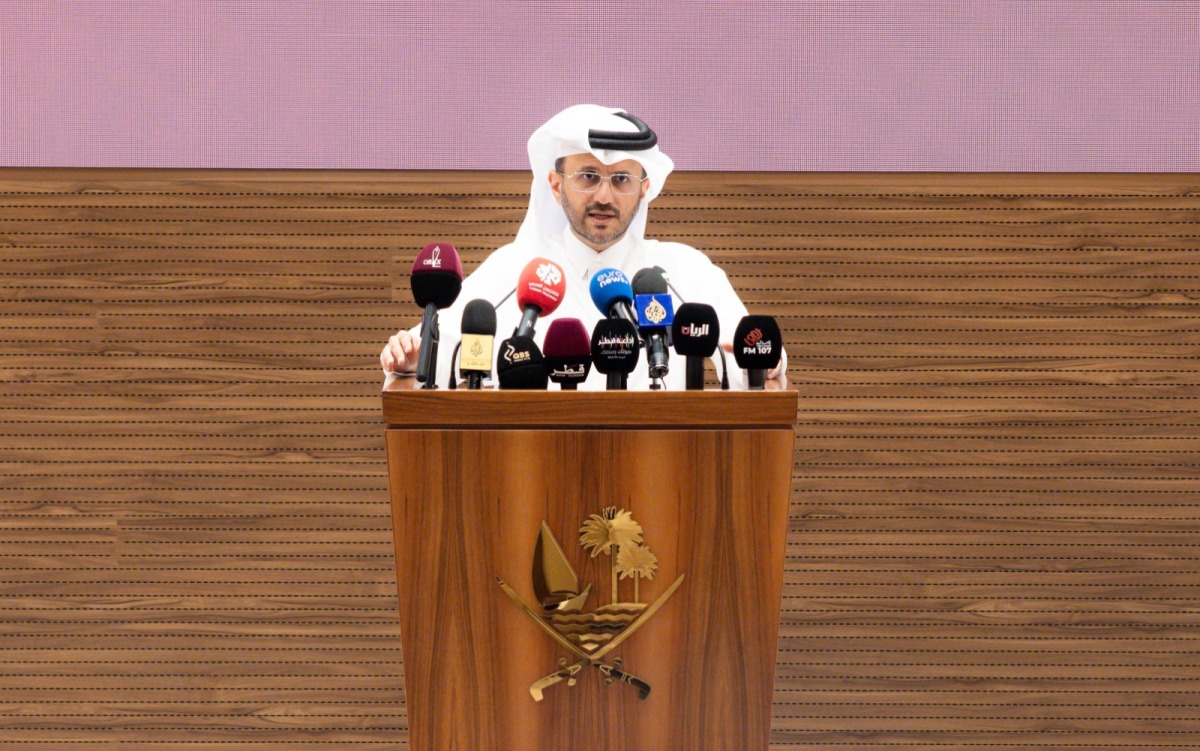
Doha: Advisor to the Prime Minister and Official Spokesperson for the Ministry of Foreign Affairs Dr. Majed bin Mohammed Al Ansari affirmed Tuesday that the State of Qatar, the Sultanate of Oman and Pakistan have been bending constant efforts to facilitate engagement between Iran and the United States to bridge their viewpoints.
He noted that coordination is ongoing between the Gulf Cooperation Council (GCC) states and regional partners to support endeavors aimed at reaching a lasting solution to the crisis.
In a weekly press briefing of the Ministry of Foreign Affairs, Dr. Al Ansari said the current priority is to contain the escalation and reopen the way for diplomatic efforts. He stressed the importance of returning to the negotiating table as the optimal off-ramp to address the ongoing disputes.
Dr. Al Ansari pointed out that regional and international de-escalation efforts and the push for a diplomatic solution are still underway, emphasizing that countries of the region are working collaboratively to avoid any new escalation and uphold the return to the dialogue path.
Mediators were consistently working to create the appropriate conditions for the resumption of direct dialogue, Dr. Al Ansari underlined, stating that he hoped these efforts would yield positive outcomes in the near future.
Stemming from its expertise in international mediation efforts, Dr. Al Ansari said that the State of Qatar does not set specific timelines to reach deals. He highlighted that the success of any agreement hinges on the extent of the readiness of all relevant parties to reach that deal.
Dr. Al Ansari further remarked that Qatari communications are ongoing at various leadership levels with relevant parties in pursuit of making a breakthrough in the negotiations path, emphasizing that no final agreement has been reached thus far.
Regarding navigation security in the Strait of Hormuz, Dr. Al Ansari stressed that the Qatari stance is firm in clamoring for ensuring the freedom of navigation in accordance with international law, and in preventing the Strait from ever being used either as a vehicle for political pressure or to achieve unilateral interests.
Dr. Al Ansari noted that the minimum demands at the current stage are to return to the previous status of the Strait, in line with international law and in coordination with all littoral and concerned nations.
He stressed that any future arrangements regarding the management of the Strait or the regulation of navigation through it must be reached through consensus among all affected countries in the region.
Ensuring the uninterrupted flow of trade and freedom of passage represents a shared priority for the international community, Dr. Al Ansari underscored.
With respect to the issue of Gaza, Dr. Al Ansari said that the statement issued by the mediators on the Israeli relentless violations in Gaza intends to hold the Israeli entity responsible for the implementation of the ceasefire deal in the Strip.
He added that efforts are still ongoing in lockstep with a variety of parties, particularly the United States of America, alongside mediators in the State of Qatar, the Arab Republic of Egypt and the Republic of Turkiye, to ensure the swift enforcement of the second phase of the agreement.
The international community has patently realized the entity that obstructs the implementation of the agreement on the ground, Dr. Al Ansari noted, indicating that the transition to the second phase - based on US President Donald Trump's plan and the support he had announced for this plan - places full responsibility on the Israeli side.
Dr. Al Ansari further recalled that the Hamas movement has been committed to what is required; hence, there are clear undelivered obligations on the part of the Israeli side under this accord.
He noted that the course of negotiations since 2023 has been marked by several instances of Israeli procrastination in implementing the terms of the agreement, pointing to the latest Israeli escalation and the targeting of civilians in the Gaza Strip, which resulted in the killing of more than 30 people.
Dr. Al Ansari described this action as a new attempt to disrupt progress in the negotiations track and impede the achievement of peaceful solutions to the conflict.
In addition, Dr. Al Ansari stressed the importance of Israeli withdrawal from all occupied territories, asserting that the occupation is unwarranted in all forms, and that the State of Qatar bases its positions on international law and the relevant references.
He called on the international community to exercise further pressure to ensure the implementation of the agreement, culminating in the reconstruction of the Gaza Strip and improving the humanitarian conditions of Gazans who have been suffering for over two years.
Regarding the telephone conversation held between Prime Minister and Minister of Foreign Affairs HE Sheikh Mohammed bin Abdulrahman bin Jassim Al-Thani and Minister of Foreign Affairs of the Russian Federation HE Sergey Lavrov, Dr. Al Ansari said that the State of Qatar has been committed to keeping all regional and international partners in the loop with respect to the evolving situation in the region.
Dr. Al Ansari stated that the implications of the current crisis go beyond regional borders, prompting the imperative of bolstering coordination and consultations with various international partners in support of efforts to reach diplomatic solutions.
Communications with the Russian side are ongoing on a variety of issues, Dr. Al Ansari assured, highlighting that the recent communication addressed the evolving regional situation and the recent developments pertaining to the diplomatic endeavors underway.
He underscored the importance of briefing international partners on the evolving progress of the negotiations, along with the efforts bent to push them forward.