Doha: The State of Qatar reaffirmed its commitment to continuing support for the efforts of the International Labour Organization, strengthening international cooperation, and working towards a work environment that is more equitable and sustainable, where technological progress goes hand in hand with social progress and its gains are translated into broader opportunities, stronger protection, and more inclusive prosperity, ensuring that people remain at the centre of policies and their ultimate objective.
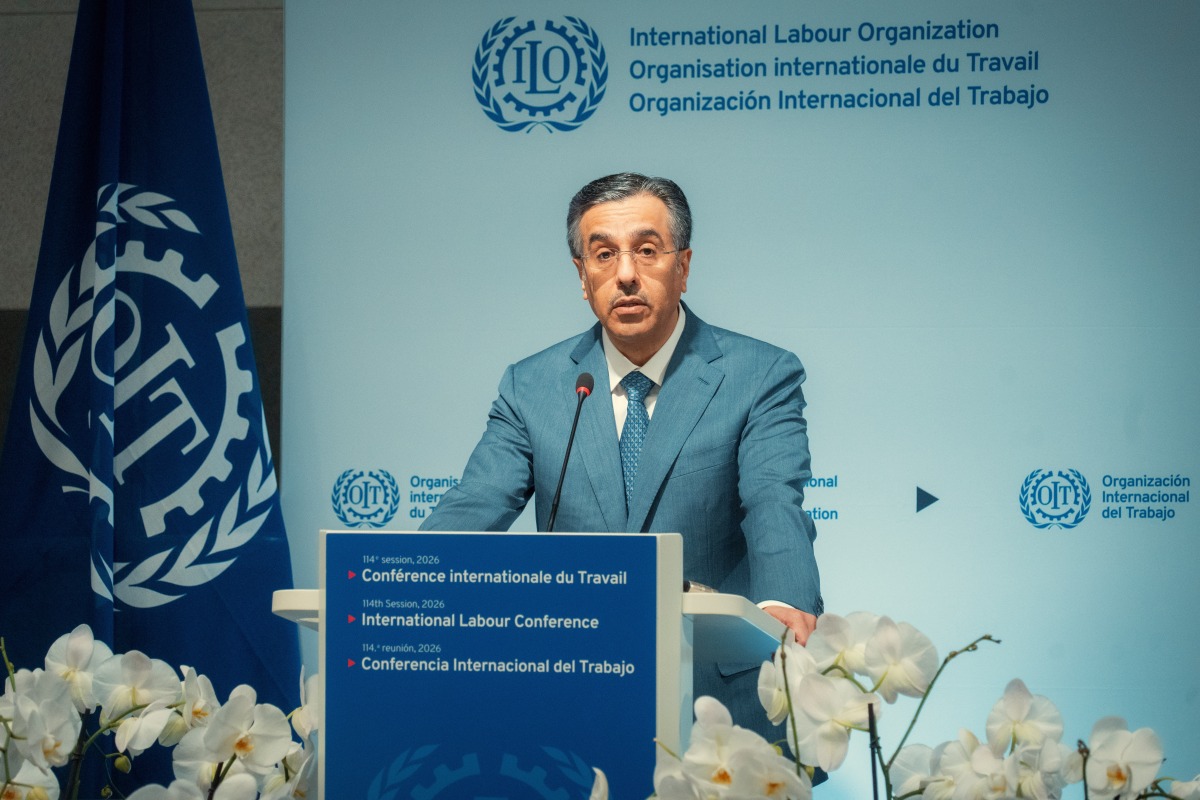
This was stated in the address delivered on behalf of the State of Qatar by HE Dr Ali bin Samikh Al Marri, Minister of Labour, before the plenary session of the 114th session of the International Labour Conference held in Geneva.
His Excellency expressed the State of Qatar’s appreciation for the important report presented by the Director-General of the International Labour Organisation entitled “Harnessing Artificial Intelligence for Decent Work”, as well as the report concerning the conditions of workers in the occupied Arab territories.
His Excellency explained that the real challenge posed by artificial intelligence does not lie in the technology itself, but rather in the choices made by governments and social partners regarding how it is utilised, noting that the future will not be determined by algorithms alone, but by policies, institutions, and their ability to direct technological transformation towards social justice and decent work.
He noted that the State of Qatar believes the success of digital transformation should be measured by its ability to achieve three interconnected objectives: increasing productivity, expanding opportunities for decent work, and strengthening social protection and skills development so that its gains are reflected fairly and equitably for workers and societies.
His Excellency explained that this vision is based on the conviction that the sustainability of any economic or technological transformation depends on the strength of labour market institutions and their ability to adapt to change, noting that experience has shown that the most successful reforms are those accompanied by social dialogue and trust-building between governments, employers, and workers.
In this context, His Excellency affirmed that the State of Qatar will continue developing its policies and institutions in ways that strengthen labour market resilience and reinforce the principles of protection, fairness, and partnership among production stakeholders.
He stressed that the State of Qatar is closely following ongoing discussions regarding the establishment of an international standard for the platform economy, explaining that this process represents an important opportunity to develop an international framework that balances encouraging innovation with safeguarding workers’ fundamental rights while promoting legal clarity, fairness, and sustainability in emerging forms of work.
He further noted that while the world discusses the future of work amid accelerating technological transformation, the challenges facing labour markets today are not limited to technology alone, as conflicts, crises, and escalating tensions are leaving profound impacts on economies and societies and directly affecting employment opportunities, living standards, and social stability.
He added that labour sector has become more interconnected than ever before, with supply chain disruptions, fluctuations in trade and energy markets, and challenges affecting global economic stability impacting workers and employers worldwide.
His Excellency emphasised the importance of strengthening international cooperation, consolidating dialogue, and prioritising peaceful solutions as fundamental pillars for achieving sustainable development and ensuring an enabling environment for decent work.
He added that while discussing the jobs of the future, the conditions of workers deprived of the most basic requirements for decent work and dignified living due to conflicts and occupation cannot be overlooked.
Moreover, he underscored the State of Qatar’s position on the necessity of protecting the rights of Palestinian workers in the occupied Arab territories, particularly in the Gaza Strip, given the destruction and complete collapse of labour markets and livelihoods witnessed there.
He further highlighted the importance of supporting recovery and reconstruction efforts to address the urgent humanitarian crisis, restore economic activity, and enable workers and their families to live with dignity and hope for the future.