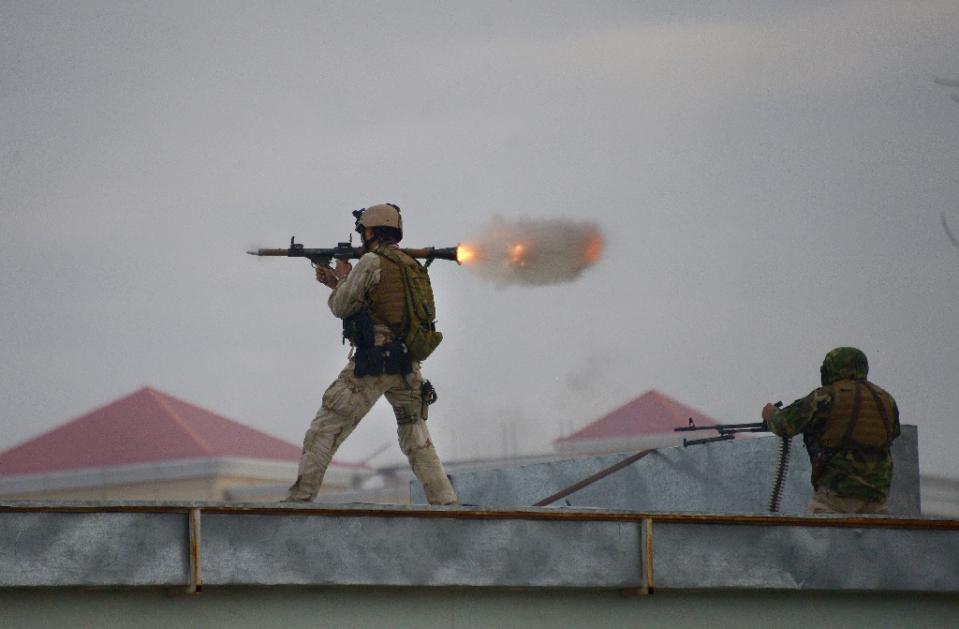

Mazar-i-Sharif, Afghanistan: Troops battled Monday to end a 24-hour gun and bomb siege near the Indian consulate in Afghanistan's Mazar-i-Sharif city, after a bloody weekend assault on an air base in India near the Pakistan border.
Separately Monday a powerful car bomb struck near Kabul's international airport, wounding at least four people just hours after a suicide bomber blew himself up in the same area.
The lethal assaults on Indian targets appear aimed at derailing Prime Minister Narendra Modi's bold diplomatic outreach to arch-rival Pakistan following his first official visit to Afghanistan last month.
No group has so far claimed responsibility for the raid on the diplomatic mission in northern Afghanistan, the latest in a series of assaults on Indian installations in the country.
Gunfights and grenade explosions echoed as commandos battled to flush out militants holed up in a building near the consulate, with powerful provincial Governor Atta Mohammad Noor overseeing the operation.
"The attackers are enemies of Afghanistan who do not want peace," Noor told reporters.
"We will suppress them as soon as possible."
But 24 hours after the siege began, security officials said they were proceeding cautiously in the residential area to limit civilian casualties.
An Indian official, who was hunkered down in a secure area within the diplomatic enclave, said all consulate employees were safe.
"We are being attacked," the official told AFP by telephone from inside the heavily guarded compound soon after the fighting erupted late Sunday evening.
Local police said some consulate employees had been evacuated.
The attack followed a raid over the weekend by suspected Islamist insurgents on an air force base in the northern Indian state of Punjab.
Seven soldiers were confirmed killed in the raid on the Pathankot base, which triggered a 14-hour gun battle Saturday and further firing Sunday.
Indian troops backed by helicopters searched the base Monday, with an official saying that the fifth attacker had been gunned down.
"We are moving step by step to sanitise the area and it's too early to say when the operation will be over," said a military official who asked not to be named.
Officials suspect the gunmen belong to the Pakistan-based Jaish-e-Mohammed, the group that staged the 2001 attack on the Indian parliament that brought the two countries to the brink of war.
The brazen attack on the air base was apparently aimed at undermining the fragile peace process between the nuclear-armed rivals.
- 'Proxy war' -
The spike in violence came about a week after Modi paid a surprise visit to Pakistan, the first by an Indian premier in 11 years.
The visit immediately followed a whirlwind tour of Kabul, where Modi inaugurated an Indian-built parliament complex and gave three Russian-made helicopters to the Afghan government.
India has been a key supporter of Kabul's post-Taliban government, and analysts have often pointed to the threat of a "proxy war" in Afghanistan between India and Pakistan.
Pakistan -- the historic backer of the Taliban -- has long been accused of assisting the insurgents, especially with attacks on Indian targets in Afghanistan.
The Taliban have also stepped up attacks on government and foreign targets in Afghanistan, underscoring worsening security a year after NATO formally ended its combat mission in the country.
A car bomb appeared to target a compound for foreign contractors near the Kabul airport on Monday evening, close to where a suicide bomber struck earlier in the day.
The interior ministry said four people were wounded in the second bombing and only the attacker died in the first.
The latest unrest coincides with a renewed international push to revive peace talks with the resurgent militant movement.
On January 11 Afghanistan and Pakistan are set to hold a first round of dialogue also involving the US and China to try to lay out a comprehensive roadmap for peace.
Pakistan, which wields considerable influence over the Afghan Taliban, hosted a milestone first round of talks in July. But the negotiations stalled when the insurgents belatedly confirmed the death of longtime leader Mullah Omar.
The attack on the consulate in Mazar-i-Sharif was the latest on high-profile Indian targets in Afghanistan.
In 2008 a car bomb at the Indian embassy in Kabul killed 60 people and the facility was again hit by a suicide strike in 2009.
Nine civilians, including seven children, were killed in August 2013 when suicide bombers targeted the Indian consulate in the eastern city of Jalalabad.
AFP