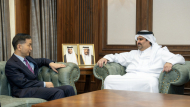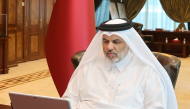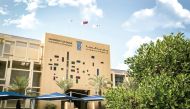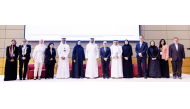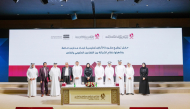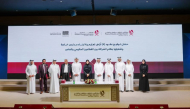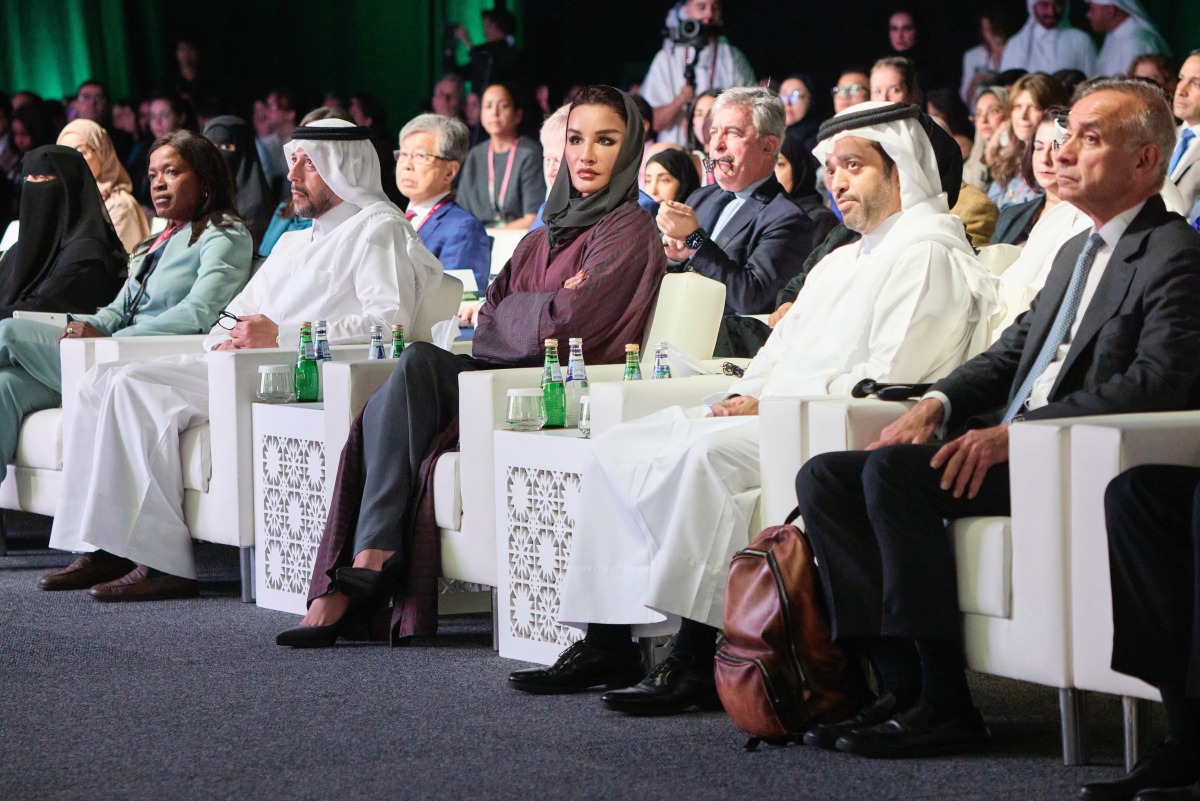
Chairperson of Qatar Foundation H H Sheikha Moza bint Nasser; Minister of Public Health H E Mansoor bin Ebrahim bin Saad Al Mahmoud, officials and participants during the opening of the Precision Medicine and the Future of Genomics Summit yesterday.
Doha, Qatar: The 11th Precision Medicine and the Future of Genomics (PMFG) Summit 2025 opened yesterday in the presence of Chairperson of Qatar Foundation H H Sheikha Moza bint Nasser, highlighting Qatar’s growing role in precision medicine and genomics.
The three-day event on precision medicine, genomics and health innovation is held under the patronage of Qatar Foundation and co-organised by Sidra Medicine and the Qatar Precision Health Institute (QPHI), set the stage during its opening session for regional and global dialogue on the future of personalised healthcare.
The opening ceremony was also attended by Minister of Public Health H E Mansoor bin Ebrahim bin Saad Al Mahmoud, senior officials, healthcare leaders, diplomats as well as high-level representatives from international healthcare and academic institutions.
PMFG Summit 2025 focuses on three major transformative pillars: AI in Genomics, Clinical Trials and Real-World Implementation; Precision Medicine Implementation/Population Genomics and Future Frontiers; mirroring a comprehensive direction to integrate research, technology, and clinical care into population-scale practice.
In her opening address, Sidra Medicine’s CEO Dr. Iyabo Tinubu-Karch underscored that the institution’s mission goes far beyond scientific discovery.
“At Sidra Medicine, it is not about research alone. It is about transforming lives through empathy, personalisation and innovation,” she said, highlighting recent patient stories that reflect the impact of precision care.
Highlighting major institutional milestones, she added that Sidra Medicine has delivered “clinical-grade genome sequencing to critically ill children,” integrated AI into paediatric therapies, and introduced “breakthrough imaging in maternal care,” allowing clinicians to predict life-threatening postpartum haemorrhage in minutes rather than an hour. These achievements, she stressed, are aligned with Qatar National Vision 2030 and the ambitions of Qatar Foundation.
Chief Research Officer at Sidra Medicine Prof. Khalid Fakhro highlighting Qatar’s early investment in science and innovation, said that “true progress can only be achieved through a solid base of science and knowledge.” He said Sidra Medicine is helping “bridge the gap between laboratory discoveries and clinical applications,” as Qatar’s scientists work towards personalised, genome-based healthcare. Prof. Fakhro said that the summit was established to “showcase advances in genomic science and their real-world impact,” stressing that the goal is “not only to map genomes, but to map the future.”
The opening ceremony featured keynote speeches by Founder and CEO of Mila’s Miracle Foundation, Julia Vitarello and Professor and special fellow of The Jackson Laboratory, Ed Liu. It concluded with a summit flagship opening panel ‘From Personalised to Population-Scale: Building a Thriving Precision Medicine Sector in Qatar,’ which discussed how Qatar can accelerate its national precision medicine agenda.
Julia Vitarello opened the panel discussion with a powerful call to action drawn from her personal experience in the rare-disease community. She underscored that severe childhood degenerative diseases represent a global health crisis, adding that breakthroughs now hinge less on scientific limitations and more on collective will and scalable systems, an area where Qatar, she said, is uniquely positioned to lead.
President of QPHI, Prof Manolis Dermitzakis highlighted the importance of scale, emphasising that population-wide genomic variability is essential to understanding each individual. He highlighted Qatar’s opportunity to build a fully integrated bioeconomy driven by research, industry partnerships, and clinical translation, noting that small nations can move faster in shaping innovation ecosystems.
From a global biotech perspective, Prof Ed Liu cautioned that successful bioeconomic development requires decades of cultural and infrastructural maturation, pointing to Singapore as an example. While acknowledging Qatar’s strong potential, he stressed the need for a realistic, diversified strategy to navigate biotech’s inherent risks and the “valley of death” between discovery and commercialisation.
Building on this, General Partner, Science Capital (London) and Strategic Investment Partner, Wyss Center (Geneva), Rana Lonnen pointed to the economic implications of innovation and urged Qatar to invest in strategic capital, strengthen tech-transfer structures, and build entrepreneurial talent, arguing that centralising intellectual property could give Qatar a competitive advantage as a small nation shaping its own innovation pathways. President and CEO of Rady Children’s Institute Dr. Stephen Kingsmore argued that precision medicine must ultimately deliver better outcomes at lower cost. He urged Qatar to prioritise investments that act as “force multipliers” for population health and integrate return-on-investment metrics into research and healthcare innovation.
While, Director of the Precision Healthcare Institute at Queen Mary University of London, Prof Claudia Langenberg highlighted the transformative potential of combining multiomics with population-scale data. She noted that such approaches have already delivered diagnostic breakthroughs in unsolved rare-disease cases and encouraged Qatar to develop robust regulatory frameworks and data-sharing agreements to attract international industry partners.