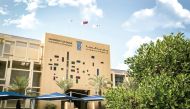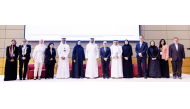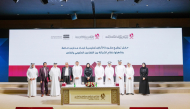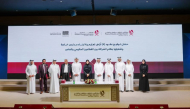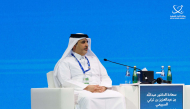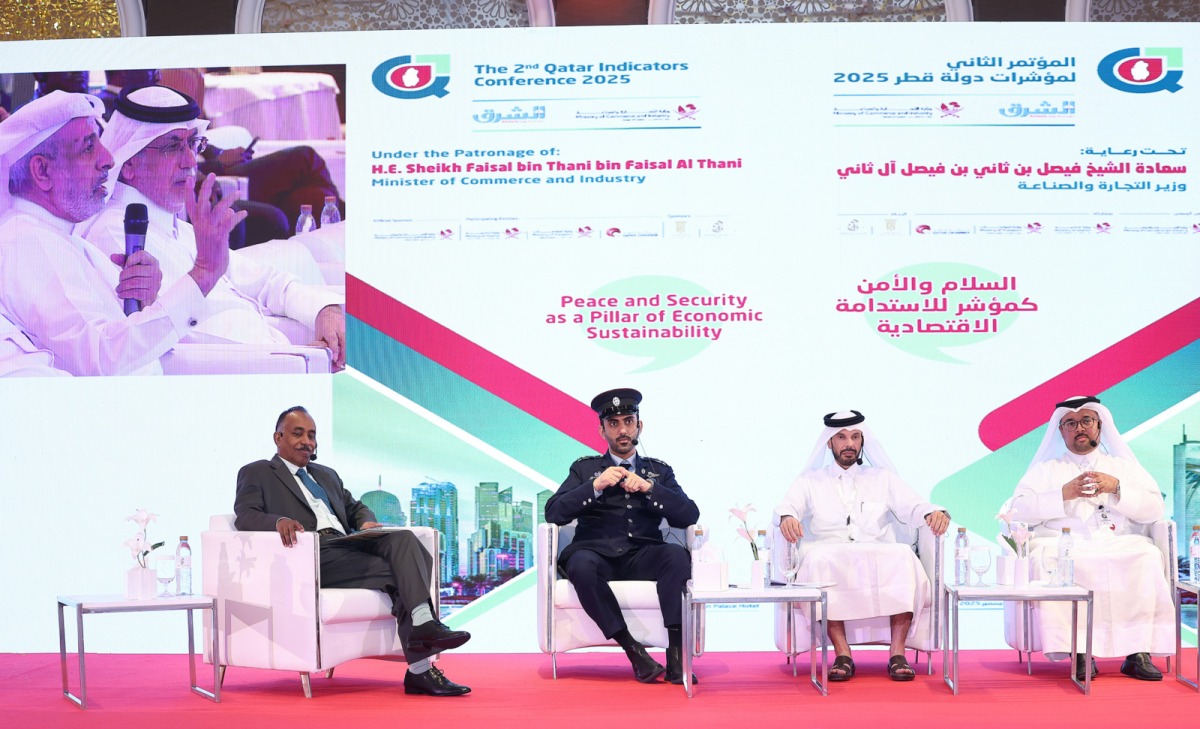
Panellists at a session held at the second Qatar Indicators Conference 2025. Pic: Rajan Vadakkemuriyil/The Peninsula
Doha, Qatar: The second Qatar Indicators Conference 2025, organised yesterday by Dar Al Sharq under the patronage of the Ministry of Commerce and Industry, opened with a high-level discussion on national indicators from the perspective of government institutions.
The first session, titled “Indicators from the Perspective of Government Entities,” featured key interventions from the Ministry of Interior, the Ministry of Transport, and Qatar Stock Exchange.
Head of Program and Project Management at the Strategic Planning Department of the Ministry of Interior, Captain Abdulrahman Mohammed Al Ansari highlighted the Ministry’s essential role in safeguarding security and public order across Qatar, protecting lives and property, preventing and combating crime, securing critical facilities, and regulating matters related to nationality, entry, and residency for expatriates.
Al Ansari underlined the Ministry’s vision to achieve regional and international leadership, supported by its mission to ensure stability, security, and public safety while continuously improving services through performance excellence.
He outlined the Ministry’s strategic objectives, which include maintaining a safe and stable society, strengthening protection against narcotics, enhancing efforts to combat cybercrime, which he described as one of today’s most rapidly evolving crime types, and ensuring safe road systems that protect lives.
Additional goals include effective crisis response, sustainable management of human and material resources, and delivering services that exceed public expectations.
Al Ansari also reviewed the international indicators in which the Ministry contributes, most notably the Numbeo Safety Index, where Qatar has maintained the first place worldwide and in the Arab region for the past five years. He added that although Qatar ranked second in the Arab world and third internationally, ongoing efforts aim to restore the top global ranking in 2025.
Director of Land Transport Licensing Department at the Land Transport Sector of the Ministry of Transport Hamad Ali Al-Marri emphasised the importance of safety and security indicators in supporting economic sustainability.
He thanked Dar Al Sharq for convening the conference and selecting two internationally significant indicators that, he said, “are essential for any state aspiring to achieve economic sustainability.”
Al-Marri explained that the Peace Index and Security Index directly shape a country’s attractiveness for investment by influencing resource allocation, productivity levels, consumer confidence, asset protection, and the growth of domestic and international trade.
He outlined the Ministry of Transport’s role through its sectoral strategy, aligned with Qatar’s Third National Development Strategy, particularly the National Logistics Services Strategy. This strategy includes initiatives and projects that enhance transport and storage indicators within the national economy.
He noted that Qatar continues to monitor cargo transport volumes, the country’s ranking in maritime connectivity, and the utilisation rates of Hamad Port and Hamad International Airport.
The latter, he said, achieved the world’s top ranking among global airports this year. Additionally, the Ministry is working to improve indicators related to import and export processing times and associated costs—factors that significantly influence investor decisions and facilitate market entry.
“These indicators are continuously analysed by specialised teams to identify projects and initiatives that raise performance levels and support Qatar’s long-term competitiveness,” Al-Marri affirmed.
Director of Investment Instruments Development at Qatar Stock Exchange Hamad Khalil highlighted the central role of economic indicators as the core communication language between governments, financial institutions, and investors.
He stressed that transparency and disclosure of financial indicators are essential for fostering stronger relationships with international investors and encouraging greater inflows of investment capital.
“The stock exchange is not merely a platform for trading securities, it is a national economic front,” he said. “A strong exchange with solid performance reflects the strength and resilience of the national economy.”
Khalil noted that QSE has taken leading steps in aligning with global benchmarks by collaborating with major international index providers.