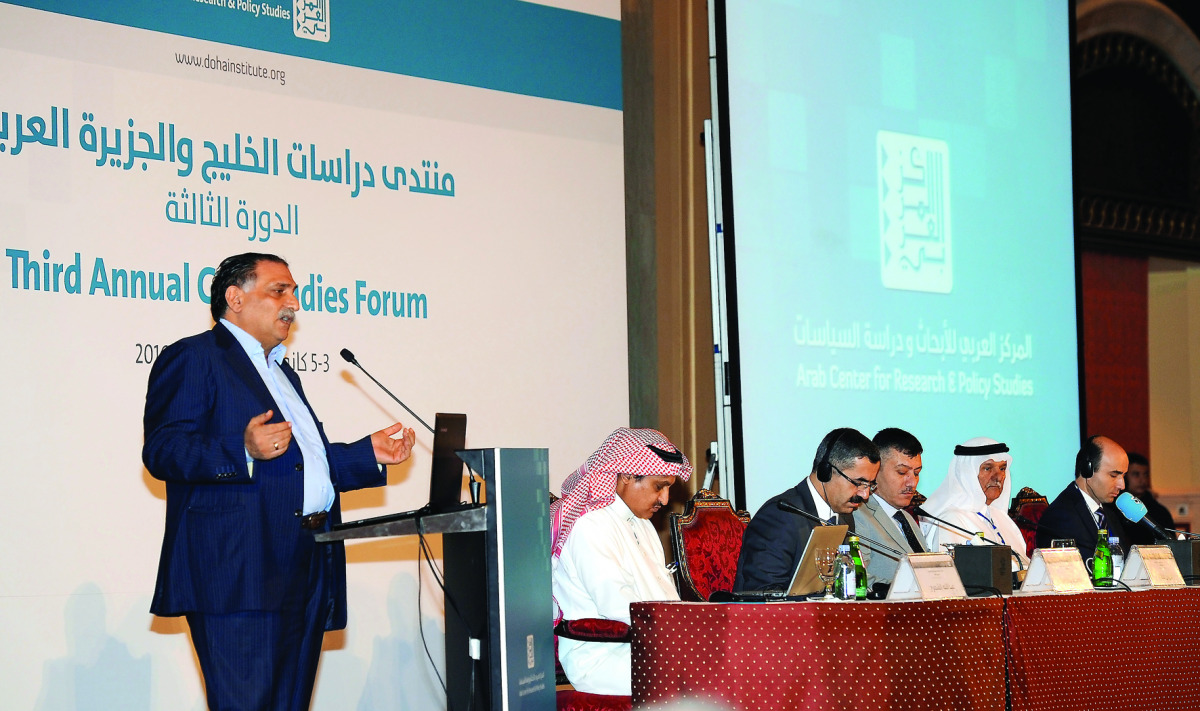
The General-Director of Arab Center for Research and Policy Studies, Azmi Bishara, addressing the Third Annual Gulf Studies Forum in Doha yesterday. Pic: Salim Matramkot / The Peninsula
With a unanimous voice, experts on the opening day of third Gulf Studies Forum observed that common security challenges induced by Arab Spring and regional wars had brought Turkey and Arab Gulf countries closer to each other further stressing the need for strengthening relations between the two sides to thwart future threats.
"Turkey and Arab Gulf states have many things in common since the Arab Spring revolutions including regional threats posed by the wars in Syria, Iraq and Yemen," said Muhittin Ataman, Deputy General Coordinator at the SETA Foundation in Turkey.
Ataman who presented a paper entitled “Turkey and the Gulf: New Realities Require New Regional Projections”, said Gulf countries and Turkey were facing common challenges along the wars in neighbouring countries, the threat of increasing number of failed states in the region, terrorist organisations like IS, and Iran’s expansion policies.
Ataman emphasised that these threats have brought these counties closer and improved their relations and suggested to develop joint political and economical projects to serve their common future. "The region is facing new realities such as hostility against refugees, Isamo-phobia, terrorism, and sectarian conflicts which need further coordination between the Gulf States and Turkey," Ataman observed.
"The Arab Center for Research and Policy Studies in his six year of the establishment has became one of the key centres in the region thanks to the unlimited support provided by the hosting country Qatar which never interfere in the centre’s researches agendas," said Dr Azmi Bishara, the General-Director of the Center. One of the major achievements of the centre along the researches, he said, was the establishment of Doha Institute for Postgraduate Studies which will be inaugurated today.
Bishara emphasised that the centre organises every year six conference which bring together 1000 researchers. "Since President Recep Tayyip Erdo?an took his presidential seat, and political changes in Saudi Arabia which brought youth to power, Turkish relationship with Gulf states has become pragmatic," said Abdullah Al-Shammari , Assistant Professor and Head of the Gulf Affairs Department at the International Middle East peace Research Center in Ankara.
There are many other factors brought Turkey and GCC countries closer including need for bolstering economic exchanges, and security requirements, said Al-Shammari, adding that there is need for coordination to manage their relation with the USA and to institutionalize the ties instead of keep it at the highest level of each state.
Mohammed Al-Misfer, Professor of Political Science at Qatar University, traced the Qatar-Turkish relation to the era of Shiekh Jassem bin Mohammed Al Thani, the founder, and Sultan Abdulhamid. "The relations witnessed significant developments and signature of several agreements covered different areas of cooperation including security, defence, economy and education," said Al-Mesfir. "Turkey supported people’s demands during the Arab Spring Revolutions although the outcomes of some of these revolutions were not always positive," said Mesut Ozcan, Director of Diplomacy Academy of MFA in his paper "Turkish Foreign Policy Towards the Middle East".