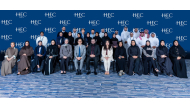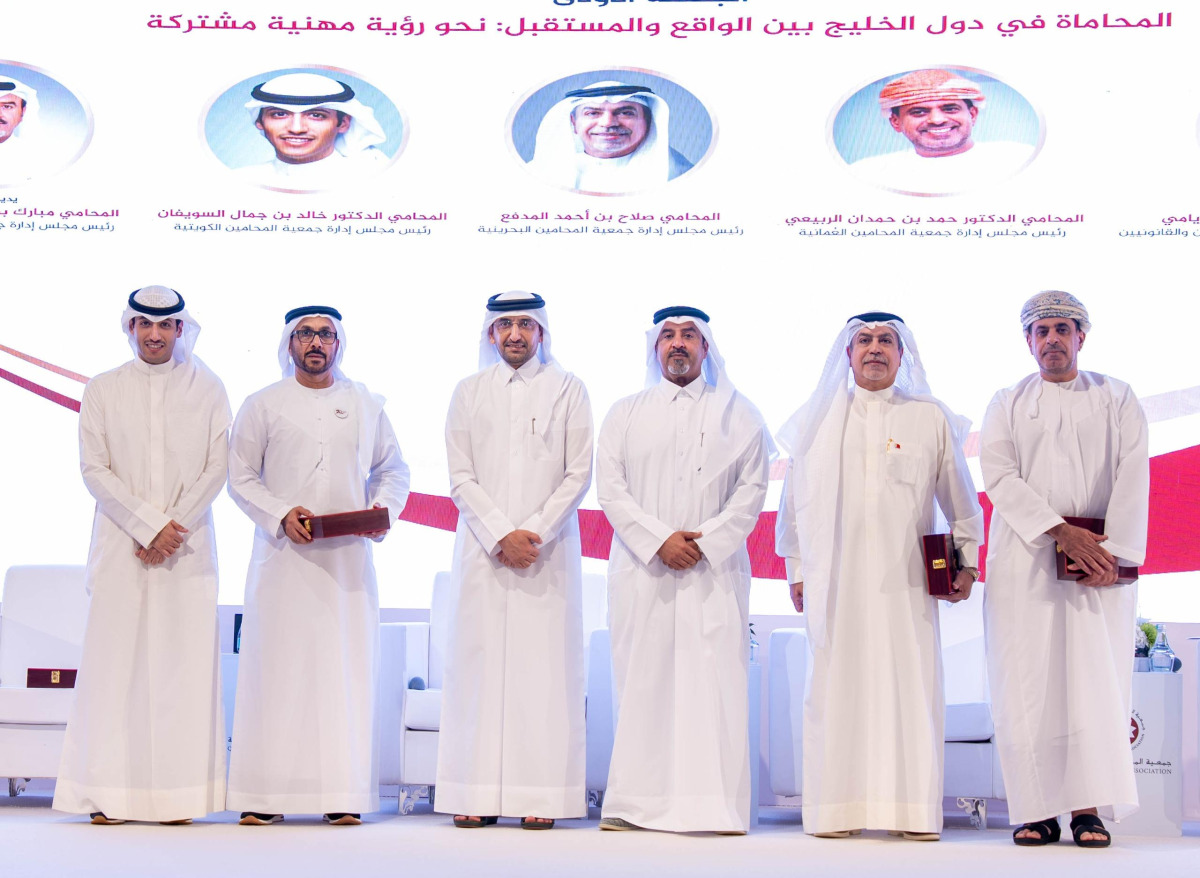
Minister of Justice and Minister of State for Cabinet Affairs H E Ibrahim bin Ali bin Issa Al Hassan Al Mohannadi and other officials during the Gulf Lawyers Forum yesterday.
Doha, Qatar: Minister of Justice and Minister of State for Cabinet Affairs, H E Ibrahim bin Ali bin Issa Al Hassan Al Mohannadi, affirmed that the State of Qatar gives the legal profession an overriding priority, as demonstrated in the nation’s move to make amendments to the Law Regulating the Legal Profession, along with the ensuing statutory decisions.
H E the Minister noted that a review of the legislative framework of this profession is underway in accord with Qatar National Vision 2030 and the Ministry’s strategy.
Speaking yesterday at the opening session of the Gulf Lawyers Forum, organized by the Qatari Lawyers Association (QLA) to mark its 20th anniversary, H E the Minister said the independence of this profession isn’t a privilege granted to lawyers, but rather a safeguard for litigants before it is a right of lawyers. He stressed that protecting the profession and preserving its integrity and independence require its members to be the first to reject wrongdoing and hold those responsible to account.
The quality of justice in any country is literally gauged by what is happening inside lawyers’ offices even before measuring what is happening inside courtrooms, as lawyers are the primary people to whom right holders resort, H E Al Mohannadi explained.
He recalled that lawyers are the first ones to listen to the stories of those right holders and ultimately decide whether a dispute deserves to be escalated to the court, emphasizing that lawyers are vested with the responsibility of clarifying the mistake when clients are wrong.
The Minister of Justice and Minister of State for Cabinet Affairs underscored the importance of technological readiness, financial integrity and proper training in the legal profession.
The Minister extended his profound gratitude to QLA for organising the forum and for its efforts to strengthen professional communication among lawyers from the Gulf Cooperation Council (GCC) states. He also congratulated the association on the 20th anniversary of its establishment, noting that over the years it has served as a voice for the profession and a partner in the pursuit of justice.
Al Mohannadi pointed out that the legal profession faces three major tests that cannot be put off. The first is technology, particularly as artificial intelligence makes its way into law firms.
He stressed that the question is no longer whether lawyers will use these technologies, but rather who will bear responsibility when a machine makes a mistake.
The Minister emphasised that responsibility remains entirely with the lawyer. A technological tool does not sign a legal brief, appear before a judge or shoulder the duty of trust owed to a client.
He noted that professional competence today invariably includes a lawyer’s understanding of the capabilities and limitations of the tools at their disposal, as well as the need to be candid with clients and the court about how those tools are used. The second test, he explained, concerns financial integrity. A lawyer is entrusted with public confidence, and a law office must never become a conduit for funds of unknown origin.
The third test is the human element. The Minister explained that legislation and procedures alone cannot produce a competent lawyer. Rather, the future of the profession rests on trainees who are learning the fundamentals and principles of legal practice today.
He questioned whether they would receive training based on sound professional standards or simply be left to learn on their own. Al Mohannadi stressed that meaningful training is a responsibility that law firms and professional associations are expected to uphold, rather than merely a requirement for admission to the roll of lawyers.
This makes it essential to strengthen the role of these institutions in preparing and qualifying legal professionals.