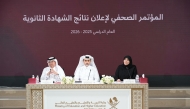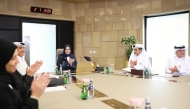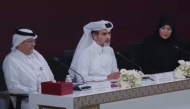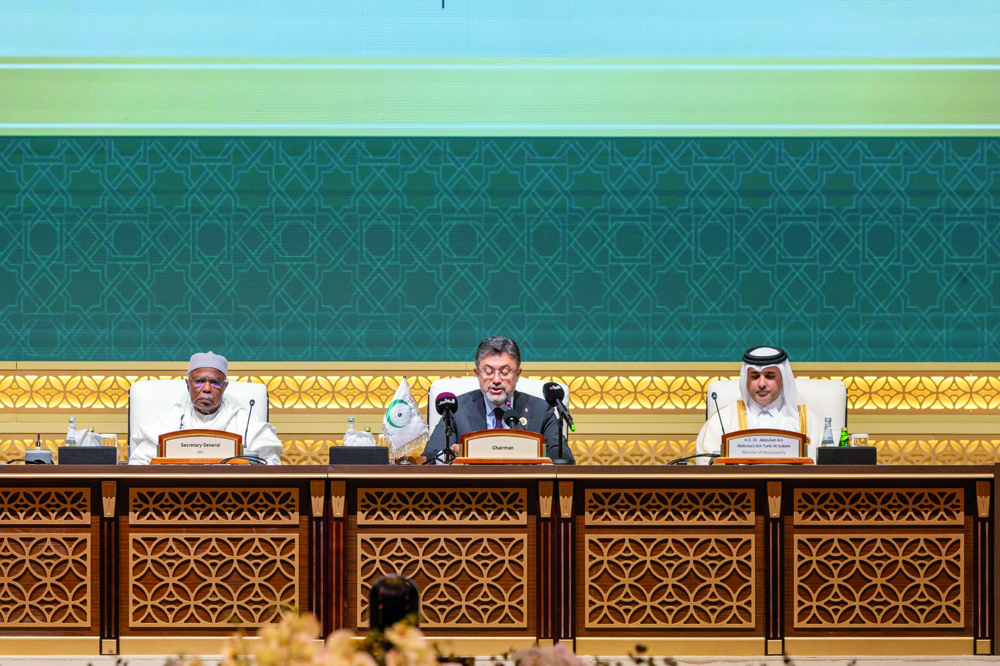
Minister of Municipality H E Dr. Abdullah bin Abdulaziz bin Turki Al Subaie (right), Minister of Agriculture and Forestry of Turkiye H E Ibrahim Yumakli (centre) and Secretary-General of Organization of Islamic Cooperation H E Hussein Ibrahim Taha during opening ceremony of 9th Ministerial Conference of OIC in Doha, yesterday.
Doha, Qatar: Minister of Municipality H E Dr. Abdullah bin Abdulaziz bin Turki Al Subaie has said that National Food Security Strategy has helped built a resilient food system in keeping pace with time.
“National Food Security Strategy has formed a buffer and a safety valve for Qatar in the face of all changes occurred in the past,” said the Minister, citing the success of the strategy in building a resilient food system that dealt very successfully with COVID-19 pandemic, international geopolitical crises, and the requirements of hosting major events such as the FIFA World Cup Qatar 2022.
The Minister was addressing the opening ceremony of the 9th Ministerial Conference of the Organisation of Islamic Cooperation (OIC), which is hosted by Qatar under the theme, ‘Towards Achieving the 2030 Sustainable Development Goals in OIC Member States’.
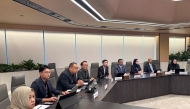
The ceremony was attended by Minister of State for International Cooperation at the Ministry of Foreign Affairs H E Lolwah bint Rashid Al Khater, a number of Their Excellencies the ministers responsible for agriculture and food security, and heads of delegations from 45 member states of OIC, eight institutions affiliated with the organisation, and two regional and international organisations.
Minister of Municipality said that Qatar is committed to achieving all sustainable development goals, especially the second goal, which is to eradicate hunger, achieve food security, improve nutrition, and promote sustainable agriculture.
He stressed the keenness of Qatar to continue fruitful cooperation and coordination with all the OIC member states and all international organisations and bodies and relevant parties to achieve the goals of sustainable development.
“Qatar, under the wise leadership of Amir H H Sheikh Tamim bin Hamad Al Thani, has paid great attention to developing the economic sectors in the country in general, and the agriculture and food security sector in particular, as it is one of the vital, important and concerned sectors for achieving food security for all residents of Qatar,” said Al Subaie.
He said that the work on plans to achieve food security began more than a decade ago. “Qatar National Vision 2030 aims to build a food system capable of resilience and responding to crises and disasters, and encourages the responsible and sustainable production and consumption of food products, while applying the highest standards of quality and safety,” said the Minister.
“It supports fair trade practices based on the standards of a diversified competitive economy, and improves living standards, which contributes to achieving sustainable development goals by creating lasting harmony between economic, social and environmental development, and achieving prosperity for our people, our economy, and our regional and international surroundings.”
Minister of Agriculture and Forestry of Turkiye H E Ibrahim Yumakli said that his country is ready to exchange information on the food security and agricultural development policies with OIC member states.
“The issues related to food security and agricultural sustainability give us the opportunity to discuss ways to enhance cooperation and solidarity, stressing that we must focus on how to build more resilient food systems so that we can address the future crises in a better way,” said Yumakli.
Secretary General of Organisation of Islamic Cooperation H E Hussein Ibrahim Taha said that the conference is closely related to various programmes that the OIC has actively sought to achieve in order to meet the current challenges of economic and social development in its member states.
He said that the agriculture in most OIC member states still faces challenges represented by low crop and livestock productivity, depletion of soil fertility, the spread of pests and diseases, declining ability to cope with the negative effects of climate change, ineffective trade and market systems, and policies that reduce economic incentives to invest in agriculture.
“Various local, regional and global conflicts have exacerbated the food security situation in many of our member states, resulting in an increase in cases of hunger, malnutrition and diseases,” said Taha.
He said that achieving sustainable development goals — such as eliminating poverty and hunger — is impossible to achieve without serious and direct attention to the development of agricultural and food systems in our countries, especially in the least developed countries of OIC.