Doha, Qatar: At the beginning of the year, the global economy was on a steady path of stable growth and diminishing inflation. This trajectory was suddenly disrupted by the Iran conflict. Prior to the beginning of hostilities on the 28th of February, global headline inflation was on a continuous downward trend from its post-Covid pandemic peak of 9% in 2022, QNB said in its economic commentary.
Price increases were gradually converging towards central bank targets across advanced and emerging economies alike. That trajectory has now sharply reversed. Global headline inflation is now projected at 4.4% for 2026, an upward revision of 0.9 percentage points from the pre-conflict forecast of 3.5%. What had been shaping up as a year of monetary policy normalization, could now turn into a new cycle of inflationary pressures defined by a major energy shock.
Following the US-Israeli military campaign against Iran, launched on February 28th, Tehran retaliated by effectively closing the Strait of Hormuz – the waterway through which approximately 20% of the world’s oil and liquefied natural gas (LNG) normally flows. Brent crude surged by more than 25% in the weeks that followed, reaching above USD 120 per barrel at its peak, before settling near USD 110 per barrel in early April, while LNG spot prices in Asia increased by more than 85% since the initial strikes. The inflationary consequences of this energy shock are already materializing.
An energy shock of this magnitude operates through two distinct channels. The first is the direct, or headline, effect: the immediate pass-through of higher oil and gas prices into fuel, electricity, and transportation costs, which is visible and felt immediately by households and businesses. The second, is the indirect effect on core inflation – the underlying price dynamics that strip out volatile energy and food components – through which higher energy costs gradually feed into production costs, wages, and services prices, embedding themselves more persistently in the broader price level. This article discusses the inflation effects across the globe, delving into the US, the Euro Area, and Asia.
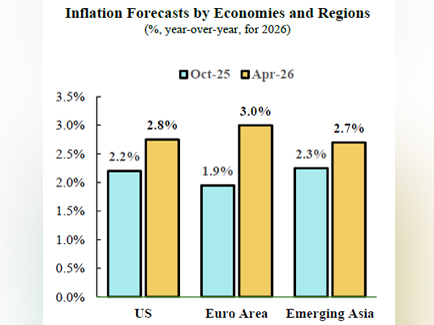
As a net energy exporter, the US is structurally less exposed to crude oil supply disruptions than Europe or Asia. However, the inflation outlook was already challenging, since tariff-driven goods inflation had been creating pressures and feeding into consumer prices. Following the outbreak of hostilities, gasoline prices crossed USD 4 per gallon, up by close to USD 1. Headline inflation surged to 3.3% year-on-year in March, well above the Federal Reserve’s 2% annual target. Core CPI, which excludes items with more volatile prices such as food and energy, came in at 2.6% year-on-year, with early signs of broadening pass-through into transportation, food, and services. With this, the IMF raised its US inflation forecast for this year to 2.8%.
In contrast to the US, the Euro Area is nearly fully import-dependent for both oil and natural gas, and therefore much more sensitive to energy price disruptions. Therefore, the consequences were immediate and measurable. The Euro Area headline inflation jumped from 1.9% in February 2026 to 2.5% in March, driven by a swing in energy prices with an annual increase of 5.1%. The shift was broad-based across the bloc’s largest economies, with Germany recording 2.8%, Spain 3.4%, France 2.0%, and the Netherlands 2.6%, reflecting structural differences in how energy prices transmit into consumer prices across member states. Prior to the conflict, the ECB had succeeded in stabilizing inflation near its 2% target after the most aggressive tightening cycle in its history. That hard-won disinflation is now under direct threat, with headline inflation expected to reach 3.0% for 2026.
The shock of the war in Iran represents a major supply disruption for Asia. The region accounts for around 80-85% of crude oil and of LNG that normally transits the Strait of Hormuz, making it structurally the most exposed geography to the closure of this critical chokepoint. The IMF projects Emerging Asia inflation rising from 1.9% in 2025 to 2.7% in 2026. China is relatively better insulated but not immune. China imports around 45% of its oil from the Middle East but has benefited from large strategic reserves, continued access to Russian energy supplies and its shift toward renewables. Nevertheless, higher energy costs are feeding into production costs for high energy-intensive sectors such as steel and chemicals, as well as for electronics. In South Asia, the acceleration is even more pronounced, with inflation projected to reach 5% this year.
The Iran war has delivered a significant blow to the global disinflation trend, with global headline inflation now projected at 4.4% – a sharp reversal from the pre-conflict trajectory. The shock is producing a broad-based inflation acceleration across major economies. In all three major regions – the US, the Euro Area, and Asia – the critical variable remains the speed at which energy supply will normalize.