New York: What will a Donald Trump or Hillary Clinton presidency mean for the Middle East?
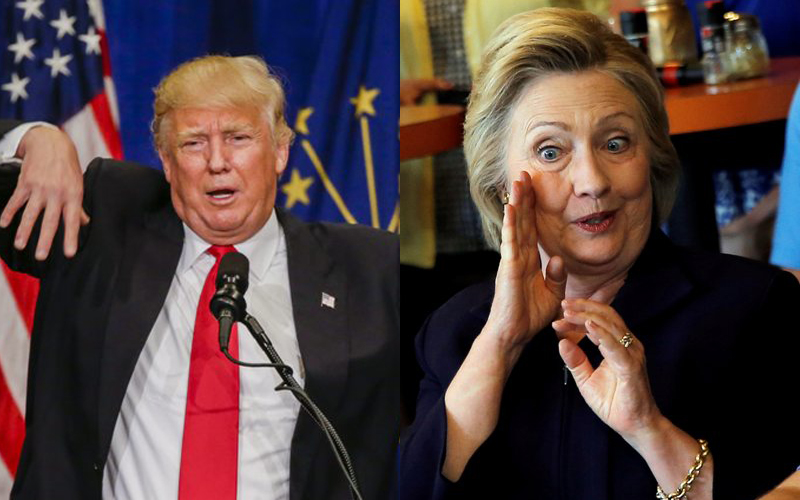
With the American presidential nominating process nearly over, it is almost certain that Trump, the real estate tycoon, will face Clinton, the former secretary of state, in the U.S. general election in November.
While plenty of sharp exchanges and personal attacks are still ahead during three intense months of campaigning, the candidates' differences on a number of policy issues have already become clear, none perhaps as striking as their positions on the Middle East.
Voters have Clinton's record as a U.S. senator and four years as secretary of state, in addition to her most recent policy pronouncements, to judge how she'd approach the region as America's 45th president. Trump has no such record and his shifting positions make him something of a wild card for voters on numerous issues. Nobody knows what his policies really would be once in office, including on the Middle East.
However, a fairly wide gulf between them has opened when contrasting Trump's primary campaign statements against Clinton's pronouncements and past actions in the region. Syria is the starkest example.
As secretary of state, Clinton took a harder line on overthrowing Syrian President Bashar al-Assad than President Barack Obama did. She favored a non-fly zone, more extensive arming of rebels, and bombing of Syrian government positions after a chemical weapons attack outside Damascus in August 2013. She has reiterated these positions during this year's campaign.
Trump, on the other hand, has said defeating Daesh is the priority and that Assad should not be dealt with until that is achieved. He has signaled that Assad's army is needed to defeat Daesh and he's welcomed Russia's military involvement, saying the U.S. should cooperate with Russia against the extremists. Clinton, on the contrary, has had nothing but harsh words for Russia.
Though Trump has largely taken a non-interventionist stance, he's surrounded himself with interventionist foreign policy advisors. And he's said he'd consider sending up to 30,000 U.S. troops to the region to defeat Daesh.
On Libya, Clinton's record is clear. She was the biggest proponent in the Obama administration of overthrowing Muammar Gadaffi and she celebrated when he was killed. But Trump has said that Libya, now plunged into chaos with competing governments and jihadists on the loose, was better off with Gadaffi in charge.
Likewise, Clinton voted as a Senator for the 2003 U.S. invasion of Iraq, while Trump says he was opposed to it and that Iraq was better off with Saddam Hussein in power.
The two also differ on Iran. Clinton was secretary of state when negotiations over Teheran's nuclear program were first discussed and she has defended Obama's nuclear deal with Iran. Trump has castigated it as the "worst possible" agreement and has vowed to scrap it if he becomes president.
Besides defeating Daesh, about the only thing Clinton and Trump strongly agree on is total support for Israel, right or wrong. Neither speak much about Palestinians' rights though both cling to the rapidly fading two-state solution.
At the recent meeting in Washington of the biggest Israeli lobby in the U.S., the American Israel Political Action Committee, Clinton and Trump fell over each other in obeisance to Israeli Prime Minister Benjamin Netanyahu, giving little hope to Palestinians that their quest for independence will be realized if either candidate is elected president.
QNA