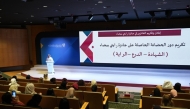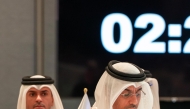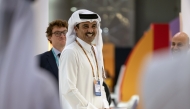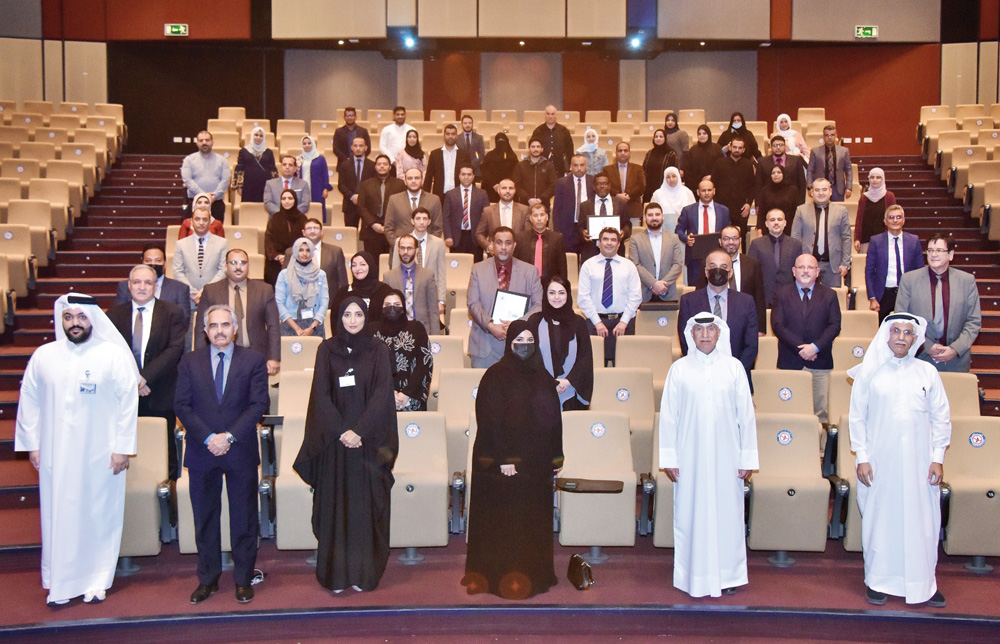
Ministry and UDST officials with training programme participants at the closing ceremony.
University of Doha for Science and Technology (UDST) in collaboration with the Ministry of Education and Higher Education (MoEHE) has completed two training programmes in Artificial Intelligence and the Internet of Things (AI/IoT) and the programming language Python.
The AI/IoT programme was delivered to 21 teachers while the Python programme was delivered to another 21 teachers.
The ceremony to mark the completion was attended by Maha Al Rowaili, Assistant Undersecretary for Educational Affairs at the MoEHE; Dr. Salem Al Naemi, President UDST; and several officials from both entities.
Participants received a completion certificate and were encouraged to use the skills acquired from both trainings to improve students' STEM learning.
Commenting on the event, Dr. Al Naemi said: “These training programmes represent a great opportunity for teachers, who will be able to introduce their students to complex subjects and different technology platforms. Our training programmes were conducted in some of the most technologically-advanced laboratories that the university encompasses. We are proud to announce that the AI/IoT training programme is a first in Qatar and marks the importance that the University places on innovation, applied education, and knowledge transfer.
“We thank the Ministry of Education and Higher Education for their trust in UDST. There is no doubt that with all the support given by the State and specifically by the Ministry, the future generations of Qatar will serve as a regional and global innovation example and will show what a smart technology implementation is capable of.”
The hands-on 28-hour training course consisted of 8 classes. Teachers enrolled in the Python training programme were able to work on variables and primitive data types, control structure, collections, and file processing, while teachers in the AI/IoT training programme were able to experiment with automated urban farming technology; home security and different types of remote sensing platforms.
These training programmes and their resultant delivery in the schools are vital in developing students’ interest in STEM (science, technology, engineering, mathematics). Furthermore, such education does not only support students’ advancement with their STEM skills, but also develops other 21st century transferable skills such as teamwork, communication, and innovation.
Training in AI/IoT and Python creates a new point of view on technology for teachers. Through these programmes, they can enhance students’ motivation to learn and explore more, ensuring that the education system in Qatar develops a progressive and adaptable generation capable of sustainable development as stated in the Qatar National Vision 2030.