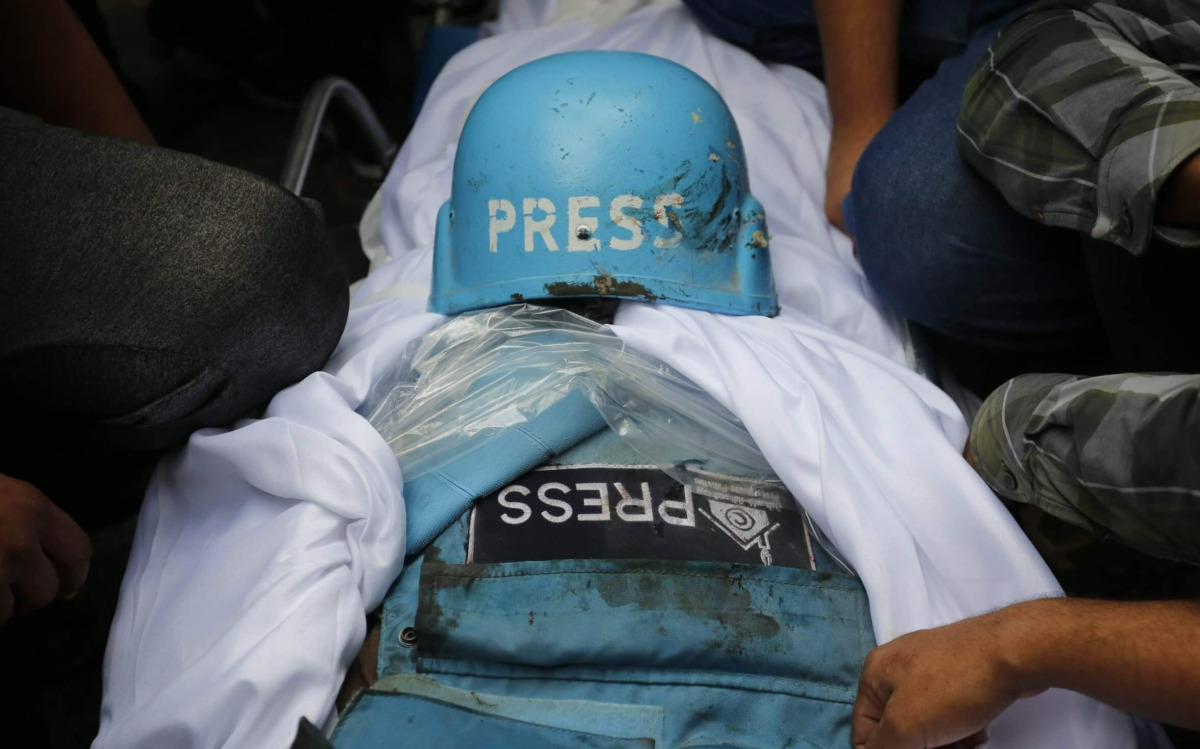
Doha: Every year on Nov. 2, the world marks the Day to End Impunity for Crimes against Journalists (IDEI) as one of the most consequential dates in the history of freedom of expression.
The United Nations General Assembly (UNGA) adopted Resolution A/RES/68/163 at its 68th session in 2013, recognizing the far-reaching consequences of impunity, particularly for crimes committed against journalists.
The landmark resolution condemned all attacks and acts of violence against journalists and media workers, urging member states to do their utmost to prevent violence against witnesses to the truth, ensure accountability, bring perpetrators to justice and guarantee that victims have access to appropriate remedies.
It also called on countries around the world to work toward creating a safe and enabling environment in which journalists can carry out their work independently.
Despite all the calls and resolutions, the targeting of journalists and media workers has remained a systematic tool used by certain actors and groups to reshape narratives, erase crimes and withhold facts from global public opinion.
Marking IDEI is an annual reminder of the dangers facing the guardians of truth. It has become a pointed reckoning for the global conscience and the international legal system, as perpetrators-whether individuals or authorities - continue to evade accountability and punishment.
Over the years, what began as a procedural loophole and a failure of law enforcement has morphed into a shield and tacit immunity, effectively giving perpetrators the green light to repeat these crimes and violations.
This year's observance highlights how emerging technologies and weapons are changing the nature of the threats journalists face, particularly in conflict zones.
While the methods used to target journalists continue to evolve, those responsible for killing them still evade accountability. To mark the occasion, the United Nations Educational, Scientific and Cultural Organization (UNESCO) is set to launch a global advocacy campaign under the slogan: "THREATS EVOLVE. IMPUNITY ENDURES".
Since 1993, more than 1,700 journalists have been killed for reporting the news and providing information to the public. In nine out of every 10 cases, the killers go unpunished, according to the UNESCO Observatory of Killed Journalists.
Impunity leads to further killings, while also serving as a symptom of escalating conflict and the breakdown of the rule of law and judicial systems.
According to UNESCO data, 189 journalists were killed in the line of duty in 2024 and 2025, a 20 percent increase compared with the preceding period. Meanwhile, 86 percent of recorded cases of journalist killings since 2006 remain unresolved or have been abandoned.
Two-thirds of the journalists killed in 2024 and 2025 lost their lives in armed conflicts, with drones responsible for 40 percent of those killings.
United Nations Secretary-General Antonio Guterres said journalists around the world continue to pay a heavy price for telling the truth. In a message marking the occasion, he added that media workers play an essential role in keeping the public in the loop about unfolding events and holding those in power to account.
Yet they are often subjected to harassment and surveillance, prosecuted, physically assaulted or thrown behind bars. In some cases, they are even tortured and killed for no reason other than doing their jobs, the UN Chief noted.
Guterres underscored the importance of justice in this regard and the urgent need to put an end to this shameful state of affairs, stressing that nothing should stand in the way of journalists seeking to carry out their work, emphasizing that this is an indispensable requirement for upholding human rights, advancing democracy and strengthening the rule of law.
Guterres also noted that experience has shown that progress is possible. He pointed to a decline in the impunity rate for these crimes in countries not experiencing armed conflict, from 94 percent to 77 percent since the launch of the UN Plan of Action on the Safety of Journalists and the Issue of Impunity in 2012, while stressing that much more needs to be done.
On the impact of the absence of justice on journalists and the public's right to know the truth, Nayef Al Nabet, a nonresident fellow at the Middle East Council on Global Affairs, told Qatar News Agency (QNA) that one aspect does not receive much attention: parties to conflicts compete not only on the ground but also over the narrative, with each side seeking to convince the world that its actions are justified and that its adversary is responsible for the violations.
Al Nabet underscored that this is where the importance of independent journalists lies, as they can offer an account that is not necessarily shaped by the calculations of the warring parties.
He noted that killing journalists and getting away with murder makes it easier to control information, making the issue far broader than media freedom. What is at stake, he emphasized, is societies' ability to know what actually happened and the evidence that may later be used to hold those responsible to account.
Asked why impunity persists despite international conventions and resolutions aimed at protecting journalists, Al Nabet said the reason is simple: international law doesn't enforce itself.
He explained that the world operates under an international system in which there is no central authority capable of enforcing the law on all countries in the same way governments enforce their laws domestically.
In this regard, he cited UN Security Council Resolution 2222 on the protection of journalists. Despite its significance, he said, the resolution does not guarantee accountability simply by virtue of its adoption.
Al Nabet further remarked that when an accused state refuses to cooperate or enjoys political protection from a major power, enforcing the law becomes substantially more difficult. This is not an issue confined to journalists; it is evident in numerous international cases, he said.
Having a legal rule in place is one thing, while having the political and institutional capacity to enforce it is quite another, Al Nabet continued.
He further stressed that double standards in international affairs and diverging political interests among major powers play a significant role in sidelining this issue. He pointed, for instance, to the way major powers deal with violations in Ukraine and Gaza.
He said there is a clear difference in the nature of political pressure and the tools countries are prepared to use, while acknowledging that the legal and political circumstances of the two cases are different.
Al Nabet emphasized that this is because countries do not make decisions on the basis of law alone; alliances, security interests and strategic calculations invariably come into play.
He added that this does not mean international law is without value. Rather, its enforcement is shaped by power relations. Countries are generally more willing to demand accountability when doing so does not run counter to their interests, he pointed out. The problem, he remarked, is that such selectivity harms not only victims but also undermines the confidence of countries and societies in the international system itself.
Asked whether the United Nations has effective mechanisms for holding those responsible for crimes against journalists to account, Al Nabet said the UN is sometimes expected to shoulder responsibilities that go beyond the authority originally granted to it by member states.
Al Nabet continued that the UN can investigate, document violations and issue reports, but it is not a world government and does not have a general criminal court capable of prosecuting everyone who commits a crime.
In addition, Al Nabet elucidated that the International Criminal Court (ICC), which is independent of the UN, faces constraints involving jurisdiction, cooperation from states and the enforcement of arrest warrants.
The issue therefore needs to be approached realistically: the problem does not always lie in the performance of international institutions, but in the fact that states have not granted them the authority necessary to enforce accountability independently, he underlined.
On the urgent steps and measures required to end impunity and ensure journalists' protection, Al Nabet called for thinking in terms of incentives and costs, rather than resolutions alone.
He said that if perpetrators expect to face no consequences, what would deter them from repeating their crimes What is needed, he explained, is independent investigations, international judicial cooperation and the prosecution of those who issue orders, not merely those who carry them out.
Targeted sanctions can also be imposed on individuals involved when sufficient evidence and legal grounds are available, Al Nabet continued.
He stressed that, above all, cases must continue to be pursued even after media attention to them wanes. Justice, he said, requires evidence, institutions and political will. Ultimately, impunity won't end as long as committing a crime carries a lower cost than refraining from it.