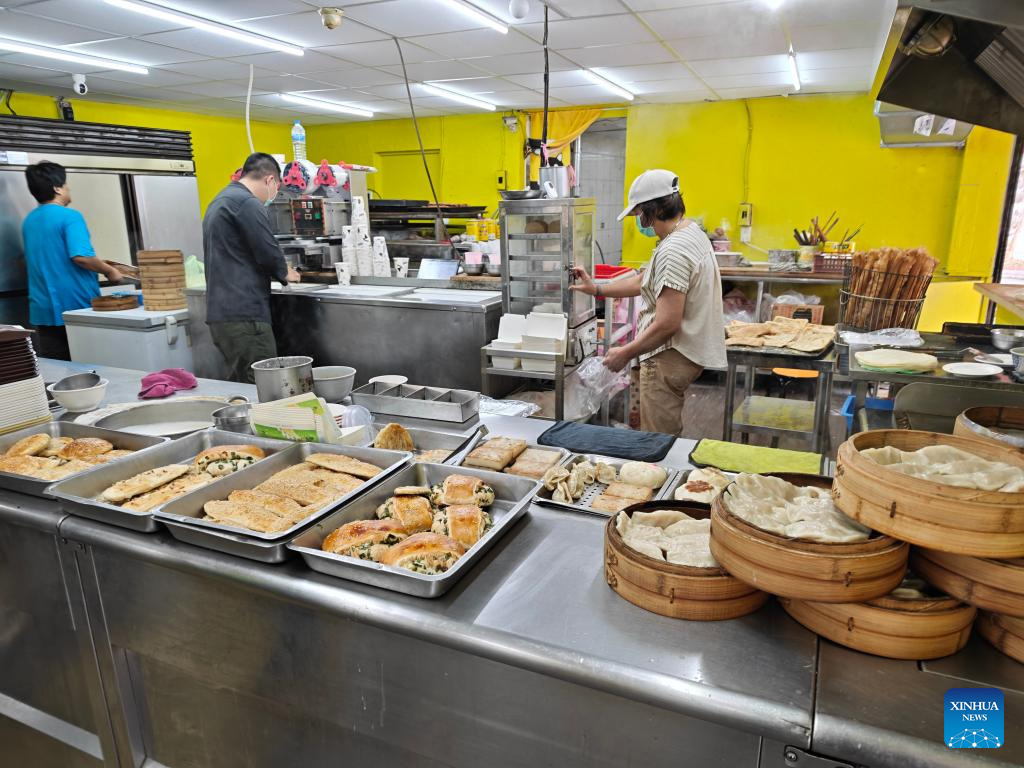
Staff work at a breakfast shop in Taipei, southeast China’s Taiwan.
TAIPEI: As Taiwan is seeing an economic boom fueled by its advantage in artificial intelligence (AI) infrastructure supply to the rapidly expanding global market, statistics reflecting ordinary people’s lives on the island tell a different story.
The island’s authority for budget, accounting and statistics earlier forecast Taiwan’s 2025 economic growth rate at 7.37 percent, significantly higher than the 5.27 percent in 2024.
However, much of its prosperity appears limited to those on the AI industrial chain.
In the first 11 months of 2025, exports of electronic as well as information and communication products surged 52 percent year on year, accounting for over 70 percent of total exports.
Meanwhile, exports of traditional industries grew by only 1 percent.
Furthermore, the island’s labor authority reported in mid-December that 378 companies had implemented furloughs affecting more than 7,000 employees, compared to over 2,000 at the beginning of the year. Most of the cases were in traditional industries.
“GDP growth feels distant, and 6 million people can only sigh over their wages,” said a recent editorial by Taiwan-based China Times, noting that the rising economic figures do not make the majority of people feel much joy, as they have not enjoyed the fruits of economic growth.
Data shows that in the first nine months of 2025, the average regular monthly salary for all employed workers in the industrial and service sectors was 47,751 New Taiwan dollars (about $1,510), while the median was 38,264 New Taiwan dollars.
The proportion of employees earning below the average rose to a record 69.77 percent, which is largely believed to be due to high-income employees in booming high-tech sectors pushing the overall average upward.
Wang Jiann-Chyuan, deputy head of the Chung-Hua Institution for Economic Research, noted in a media interview that Taiwan is facing a worsening “M-shaped” income problem and industrial polarization.
Many observers have expressed similar concerns about the imbalance in economic development. Lin Chien-fu, a senior Taiwan-based economist, said that while high-tech industries are enjoying AI dividends, traditional service sectors are still struggling in a low-wage predicament, showing that economic gains are not being evenly distributed.
Ruey Yau, an economics professor at Taiwan’s Central University, warned that the AI industry is subject to cycles and fluctuations, and future export momentum may not grow rapidly every year.
An editorial by the United Daily News said the authorities must not focus solely on the “star” sectors while neglecting the declining traditional manufacturing and service industries, which employ 70 to 80 percent of the entire workforce. “Many of these workers are experiencing a strong sense of relative deprivation due to unequal income and wealth distribution,” it said.
Adding to wage concerns is the rising cost of living. In the first 11 months of 2025, meat prices rose 4.57 percent year on year, fruit prices rose 9.4 percent, and dining-out prices rose 3.41 percent.
Complaints about high prices have been mounting, whether in supermarkets or restaurants.
A weak currency and the export-oriented growth model are seen as part of the reasons behind. An earlier article in The Economist argued that Taiwan’s undervalued currency has been “punishing consumers” and depriving them of the fruits of growth.