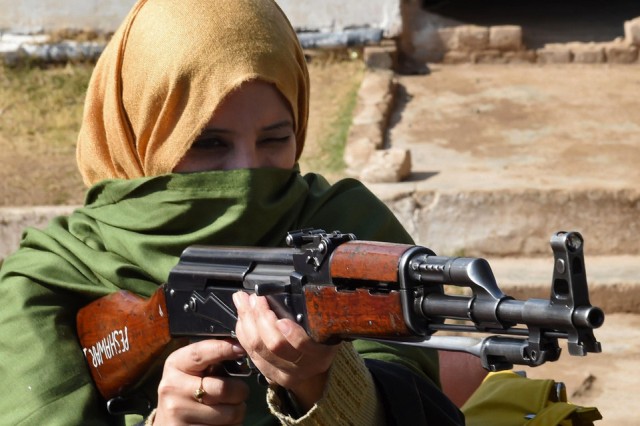

PESHAWAR: Rozia Altaf, Deputy Superintendent of Police (DSP) in Pakistan’s Khyber Pakhtunkhwa province, has a strong affinity with her police force and believes the profession suits her. However, Altaf initially had no plans of entering the police force.
“At first, I was unsure of what I was doing,” Altaf said. “But gradually, I realised there is nothing else that I want to do in life.”
Many years later, she became a DSP in Peshawar and is now known for her commitment to her vocation. She wears the silver tag with pride.
Altaf belongs to a Kashmiri Rajput family. She graduated from University of Peshawar 15 years ago and applied for the police commission seats and was appointed as Assistant Sub Inspector (ASI).
“I knew academics will take me only so far,” Altaf said. “But I wanted to work for my country, which is why I decided to join the police force.”
The 39-year-old added she looks after 10 police stations in the city.
“You feel comfortable with yourself and relaxed when you work for your country,” she said. “Terrorism had gripped the city when I became a DSP. Every single second was risky, but I love my work and never once have I regretted joining the police.”
It was 1999 when she started her career. She was sent to Police College, Sehala in Rawalpindi for one-year probation training period.
When she returned to the city, she was appointed sub-inspector. After some time, she was promoted and became an inspector, and was assigned to the reporting centre at Town police station.
Altaf served as female in-charge for a year. After the completion, she was sent to Motorway Islamabad where she served as a traffic warden for three years. She was sent to Hangu for further training. She worked in Punjab, and when she came back, she was appointed a DSP.
“Policing is a tough, different, time-consuming and nerve-wrecking job. Its work can only be done with sincerity and devotion,” Altaf said.
She was the first female from her family to join police.
“It was not easy to get here. In my family, most people pursued medicine. But I was the first one in my family to join the police,” she said.
“As women, we go through several struggles and have to move beyond cultural norms to claim our place in society. You have to become blunt and aggressive when you work in this field. You are dealing with all sorts of people,” Altaf added.
She has 10 police stations under her control and three of them, Yakatoot, Hashtnagri and Banamarhi, are considered to have the most criminal activities. Every time she visits a crime site, she calls her mother and asks her to pray for her.
“Women should not be confined to the professions of medicine and teaching. But the patriarchal norms dictate that we work in these fields only, and we let them,” she said.
“We need more women to join professions like police, law, politics and others. This is what helps the country develop,” Altaf said, adding she has no plans of getting married as yet.
Internews