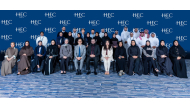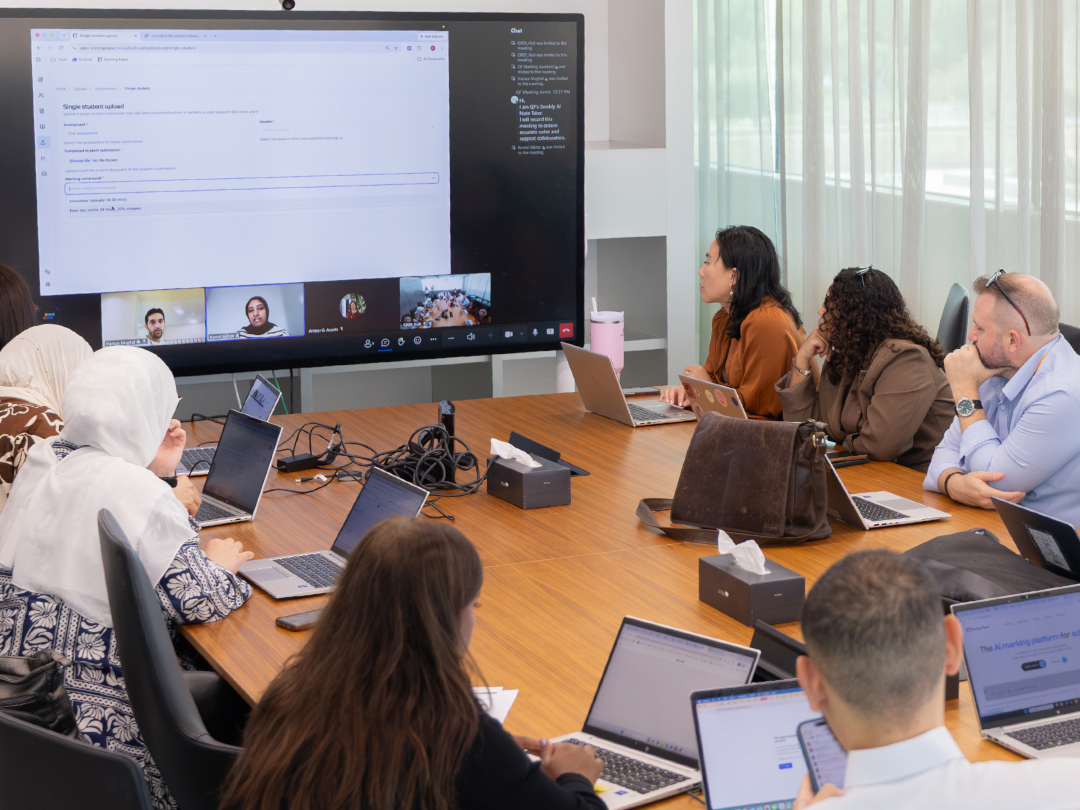
Teachers take part in a professional development workshop organised by the WISE EdTech Testbed initiative.
Doha, Qatar: The traditional classroom is evolving. The teacher, who once stood at the centre of the learning experience, is increasingly sharing that space with a different voice: the learner.
Amal Khamis Al-Hafi is an educator at Qatar Academy Msheireb (QAM) — part of Qatar Foundation’s (QF) Pre-University Education (PUE) — and has been part of the QF ecosystem for 15 years. She began her journey at Awsaj Academy, also a QF school, before moving to QAM where she now overseas Arabic Language, Islamic Education, Qatari History, and Citizenship from Kindergarten 3 through Grade 5.
Reflecting on the changes she has witnessed over the past 15 years, she says: “We have gradually moved from a model centred on the teacher’s voice as the primary source of knowledge to an environment in which the learner’s voice is present, active, and influential throughout the learning journey.
“If the past decade has taught us anything, it is that the most impactful learning does not take place when we, as educators, speak more, but when we give learners greater space to speak, ask questions, discover, think, make mistakes, try again, and arrive at meaning for themselves.
“We have moved from learners being listeners in the classroom to becoming voices within the classroom; from being recipients of learning to becoming partners in shaping it. This is not the end of the journey of educational development, but rather the beginning of a new phase of education – one that believes every learner has a voice, every question has value, and every experience is an opportunity to learn.”
Manager of the Innovation and Testbed Program at WISE — a global education think tank and an initiative of QF — Shahd Dauleh, explains that research consistently shows learning improves when students actively engage in thinking rather than passively receive information: “A large meta-analysis of undergraduate STEM courses found students in traditional lecture settings were about 1.5 times more likely to fail than those in active-learning classrooms.”
Dauleh highlights that the Education Endowment Foundation, an independent charity dedicated to breaking the link between family income and educational achievement, identifies metacognition and self-regulation as particularly effective approaches to improving learning outcomes. Its research suggests that explicitly teaching students to plan, monitor, and evaluate their own learning can significantly improve attainment while requiring relatively low levels of financial investment.
“At the same time, the research is equally clear that unguided discovery doesn’t work well, especially for novices. Data has repeatedly shown the best outcomes where inquiry is combined with strong teacher direction. So, the real shift isn’t from teacher to student. It’s from the teacher as the source of information to the teacher as the designer of thinking.”
In practice, Dauleh explains, building active partnerships between students and educators means involving learners in setting goals, giving them meaningful choices in how they demonstrate understanding, inviting structured feedback on teaching approaches, and including them in decisions about the tools and environments in which they learn.
For teachers, this shift involves more than adopting new tools. It requires evaluating their effectiveness against a shared framework in their own classrooms, with their own students. This process also develops the reflective, evidence-informed judgement that learner-centred teaching depends on.
For learner-centred education to become the norm, Dauleh identifies three essential components: assessment, evidence, and time and trust for teachers.