

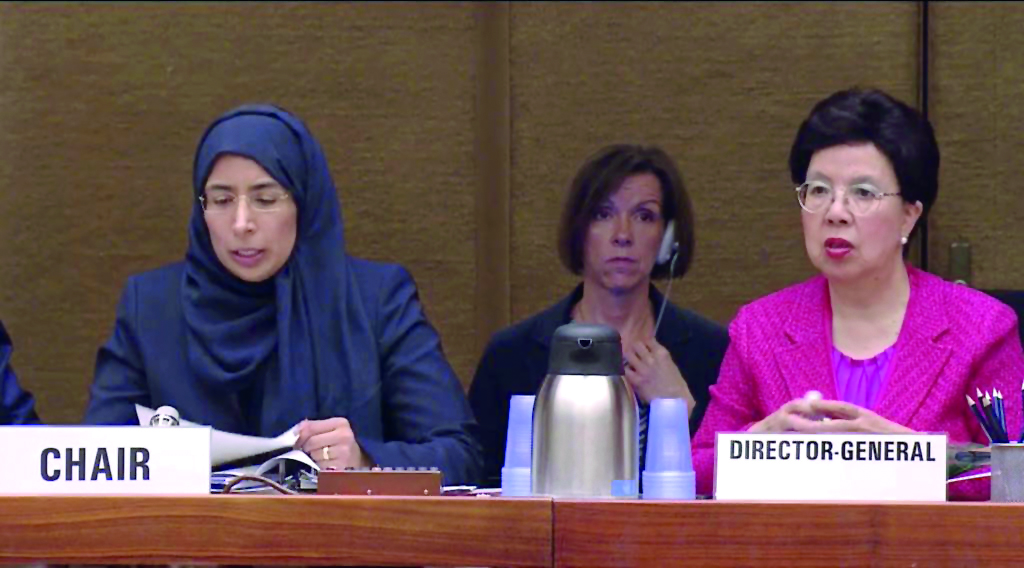
H E Dr Hanan Mohamed Al Kuwari, Minister of Public Health, during the World Health Assembly’s meeting, held in Geneva.
Hamad Medical Corporation (HMC) is continuing to support the World Health Organization’s (WHO) first global health sector strategy to eliminate viral hepatitis by 2030 through raising awareness and understanding of the disease as well as increasing access to diagnosis and interventions.
World Hepatitis Day, observed on July 28, provides an opportunity to add momentum to ongoing efforts by the WHO to eliminate the viruses that primarily attack the liver. The world health day prompts the global community to come together to drive action and influence real change in disease prevention, access to testing, treatment, and care.
There have been no major incidences of the disease in the country in recent years and every child born in Qatar is vaccinated against hepatitis B as part of the government’s childhood immunisation programme. Additional strategies implemented in Qatar for the elimination of hepatitis include testing of all blood and blood products before transfusion, premarital screening for hepatitis B and C, screening of all healthcare workers as part of the licensing process and providing the vaccine free of charge for those who were found not to be immune to hepatitis B.
During the World Health Assembly’s recent Committee A meetings, held in Geneva and chaired by H E Dr Hanan Mohamed Al Kuwari, Minister of Public Health, the Global Vaccine Action Plan and the Global Response to Vector Control were reviewed as part of the group’s focus on monitoring and responding to communicable diseases. Last May, the World Health Assembly endorsed the Global Health Sector Strategy (GHSS) on viral hepatitis 2016–2021. In line with the WHO’s strategy, the GHSS calls for the elimination of viral hepatitis as a public health threat by 2030.
HMC’s Infectious Diseases Unit Senior Consultant, Dr Hussam Al Soub, said that viral hepatitis is caused by five main viruses, referred to as types A, B, C, D, and E. “Viral hepatitis is considered a silent killer. An infected person may show limited or no symptoms. When there are symptoms, they include jaundice (yellowing of the skin and eyes), dark urine, extreme fatigue, nausea, vomiting, and abdominal pain,” said Dr Al Soub.
He explained that hepatitis A and E are typically transmitted through contaminated food or drinks. Hepatitis B and C can be contracted by needle sharing (when a syringe is shared by more than one person to inject intravenous drugs).
“Hepatitis can also be caused by the transfusion of contaminated blood or blood products, especially in places where blood is not tested properly; through a mother to her child during pregnancy; and by sexual contact.” Dr Al Soub added that people with hepatitis B can also be infected with hepatitis D, resulting in more severe complications.
“If a person is infected with hepatitis A and E, the infection will most likely go away on its own and without the ongoing liver disease. Hepatitis B and C, on the other hand, can become chronic and lead to cirrhosis and liver cancer,” said Dr Al Soub, highlighting the importance of regular medical check-ups for early detection.
“Pregnant women should be tested for hepatitis B and C so that if they are infected, protective measures such as the hepatitis B vaccine and immunoglobulin can be given to the newborn baby. Otherwise, there is a 90 percent risk that the child will become infected,” Dr Al Soub added.









