Advisor to the Deputy Prime Minister and Minister of Foreign Affairs and Spokesperson for the Ministry of Foreign Affairs Dr. Majed bin Mohammed Al Ansari stressed that the State of Qatar constantly reviews how it can impact the world and maintain its national security.
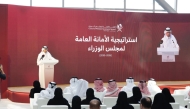
He was speaking at a session of the London Second Century Conference, organised by the Royal Institute of International Affairs (Chatham House). Al Ansari said that Qatar’s review of its policies as well as regional and international developments yielded a new theme for it’s foreign policy of being a trusted international partner.
In plenary session titled “Perspectives on the future of global order” discussed three potential scenarios for international politics. He said that current global developments are affecting what smaller and medium powers like Qatar can do at the international arena.
He said that there are three possible paths: The first is that large powers and competing powers around the world will be set free from the restrictions imposed by the global order. He said that, in that path, the characteristics of the global order since the end of the cold war will be lost. He noted that such a world will be chaotic in nature, motivated by national interests without regard for international needs.
The second path is related to liberalism’s inevitability. Al Ansari noted in this regard that, since World War II, any country had to embrace a path towards liberal democracy regardless of that country’s place in the world under that path. He expressed his belief that this characteristic could change if there is agreement on the essence of the global order and the prevalent values today. He added that such an agreement could open up a way to a broader system that accepts different models of political development, in return for maintaining the essence of the global system.
The third path would be similar in many ways to pre-World War II, when there wasn’t a full-formed global order and things are resolved on a case by case basis. He added that the world has already seen the result of adopting such a path in the past.
Al Ansari pointed out that regardless of whether one of these paths will be reached or a combination of them, the biggest challenge will be for small countries to try and figure out how to survive these troubled waters. Al Ansari pointed to a new study that discusses the challenges facing 27 democratic countries’ political system. He added that such challenges reveal a changing scene, in which conflict and instability are not confined to the developing world only, but also infiltrate even the historical liberal democracies, and therefore smaller countries such as Qatar will be the most affected by moving quickly towards removing the constraints regulating the world order.
Dr. Al Ansari underscored that he believes the confidence in the international system is fairly weak and is eroding between states. He deemed that as one of the major causes of events unfolding worldwide, adding that the confidence has been lost in the international system mechanism, in addition to the security, regional and global structures.
However, with regard to ways of safeguarding democracy and advancing it locally, he indicated that the state of Qatar believes in the significance of popular participation and the state managed to make the political system more participatory, pointing out that the state of Qatar has recently conducted legislative elections for the first time in history.
Dr. Al Ansari stated that it is incumbent upon us to be realistic pertaining to the application of the democratic rule models worldwide, as democracy is not essentially the key solution everywhere, and the good governance and popular participation are not synonyms to the democracy, but rather part of it and are evident indication of a grown democracy.