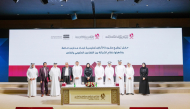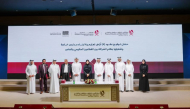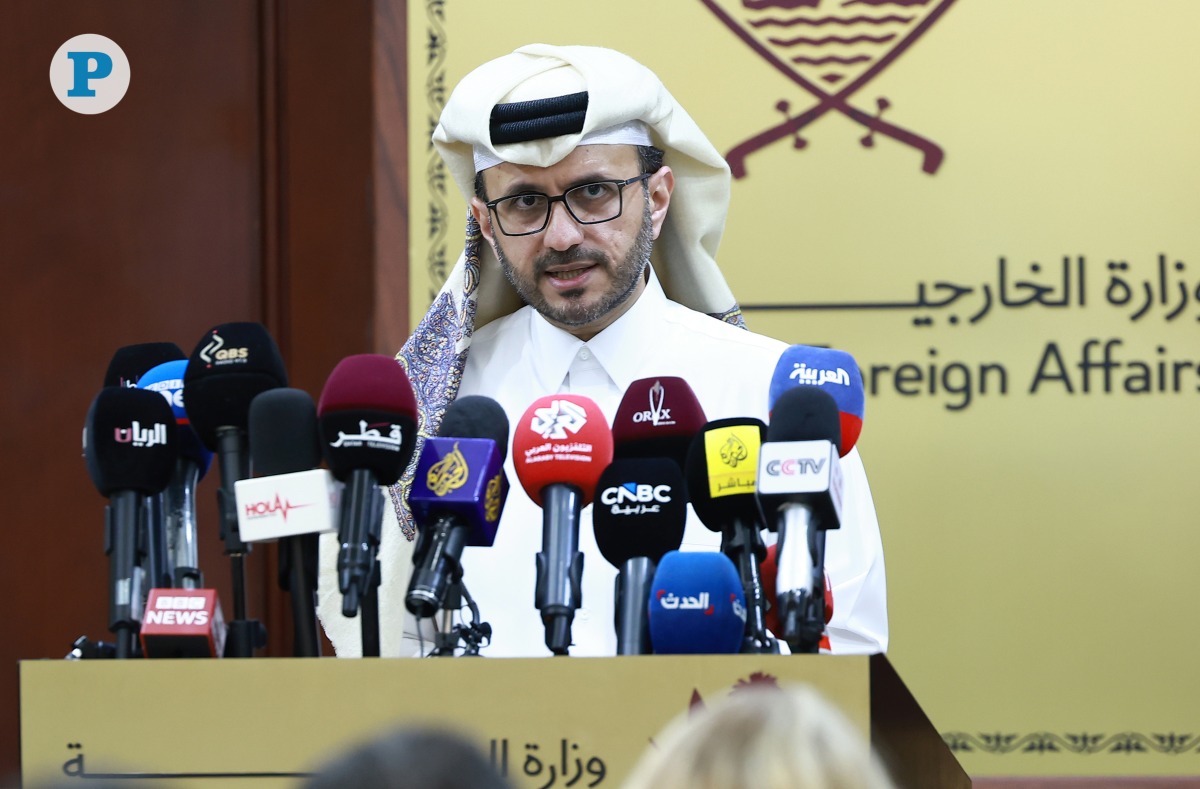
Advisor to the Prime Minister and Official Spokesperson for the Ministry of Foreign Affairs Dr. Majed bin Mohammed Al Ansari
Doha, Qatar: Advisor to the Prime Minister and Official Spokesperson for the Ministry of Foreign Affairs Dr. Majed bin Mohammed Al Ansari has called on all parties to the war to refrain from targeting vital civilian infrastructure.
Al-Ansari further called upon all parties to the conflict to refrain from attacking energy and nuclear infrastructure and urged them to return to the negotiating table. “Since this escalation began, we have warned against targeting vital civilian infrastructure. We have said it very clearly that this is a threat to all of us in the region. This region depends heavily on desalination (plants). Therefore we see this as a very big threat to the people’s lives here in the region, and we condemn all attacks on civilian infrastructure as completely unnecessary and very dangerous for the whole region.”
He also said Qatar is not involved in the ongoing mediation efforts while it supports mediation efforts by Pakistan. “Our efforts are centred on defending our homeland. However, we have ongoing communications with all parties, including the mediators as well as other regional players. What we should emphasise here is that we fully support the endeavours made by Pakistan and we hope it will bear fruits and bring about permanent peace and stability in the region,” Al Ansari said in a weekly media briefing held yesterday.
When asked at what point Qatar anticipates its mediation role, Al Ansari said, “Regarding mediation, obviously, we are now under attack. And that doesn’t put us in a place where we can be an active mediator. And our main concern right now is defending our country against the Iranian attacks that are coming in. But we have always said also that we support and welcome diplomatic initiatives around the world that are working with war parties to find a way out of this.”
He added: “We’ve always said that these conflicts end on the negotiation table, regardless of the damage that is done to war parties. And therefore, the sooner we get to the negotiation table, the better it is for all the people of the region.”
Regarding Iranian attacks on Qatar’s infrastructure and its effects on diplomatic relations, he said that Qatar has taken diplomatic action against the attacks by expelling some Iranian diplomats. “We haven’t reached a situation severing all diplomatic relations because we still see an opportunity for a diplomatic resolution with the mediation that is ongoing with Pakistan. We do not accept the premise of the attacks on Qatar, we see this as a catastrophic effect on the relations.”
Speaking on the closure of Strait of Hormuz, he said that although the issue is regional, it has repercussions for the entire world. “The future of the Strait of Hormuz should be decided by the entire region.”
“The closure of the Strait of Hormuz in this manner, and the threat it poses to the energy industry in the Arabian Gulf region, constitute a real threat to global energy security as a whole. We have seen its impact today on global energy markets—not only in terms of prices, but also in terms of shortage.”
He continued, “I believe that Qatar is moving broadly within this framework in coordination with all our international partners. H E the Prime Minister and Minister of Foreign Affairs addressed this issue as a key topic during his visit to Washington. It was a central issue in discussions with the United States regarding the overall outlook and the major economic challenges involved. Qatar remains committed to global energy security, ensuring the safety of supply chains and the stability of international markets.”
When asked about a potential US land attack on Iran, Al Ansari declined to comment on operational strategies of any parties to the war, adding that the country is against any form of escalation. “Further escalation in the region will mean more losses for both parties. And we’re trying to find a way that doesn’t include more losses of life on any side,” he added.
“First of all, let me state it again very clearly, we are against any escalation that could endanger the stability of the region any further. We are not going to comment on the operational strategies of the war parties, but what we will say is that any kind of escalation that goes beyond the current parameters of the conflict threatens further destabilization of the region.”
To a question about Iran’s crossing of redlines in its attacks on GCC countries, he replied, “The attacks on our people, our infrastructure, and our sovereignty have persisted since the beginning of the war and therefore a lot of these redlines have already been crossed. I wouldn’t say that there are many left, but obviously (in case of) further escalation, further attacks on our sovereignty, we still maintain the right of self-defense. Our forces are doing everything possible to make sure that all of us are safe here, but we have to find an end to this crisis because this spiraling escalation is just getting worse and worse in the region.”
He added, “When it comes to spiraling further, I don’t want to start describing two or three scenarios here, but very obviously we see the danger of the attacks on energy facilities, on nuclear facilities, on desalination plants, on electricity grids. All of this civilian infrastructure is the most vulnerable in any war.”
“This is a very dangerous precedent. Therefore we are calling on all parties to refrain from attacks on civilian infrastructure. The people of the region are not part of this war. The people of the region must not be the targets of this war. They need to be protected by protecting civilian infrastructure.” To a question about stance of other Gulf countries regarding war, he said, “Our understanding is that there is a unified position in the Gulf on escalation and on ending this war.”