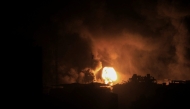
Washington: The Pentagon is expanding its cyberattacks against the Islamic State group's computer networks, senior defense officials said Monday as they claimed to have seized the momentum in the 18-month-old fight against the jihadists.
Defense Secretary Ashton Carter and the US military's top officer, General Joe Dunford, told reporters the United States was determined to "accelerate" the anti-IS campaign and indicated cyber warfare is playing an increasingly important role in doing so.
The US-led coalition is working to disrupt IS's command chain "to cause them to lose confidence in their networks," Carter said.
He did not offer technical specifics on how the coalition was doing this but said the tactic was to "overload their network so that they can't function, and do all of these things that will interrupt their ability to command and control forces there, control the population and the economy."
The US-led coalition started bombing IS positions in Iraq and Syria in late August 2014 but the campaign has expanded to include the training and equipping of local anti-IS forces, principally by Western commandos.
While the IS group maintains a firm grip on vast areas of Iraq and Syria, the jihadists have suffered some serious setbacks. In Iraq in December, coalition-supported Iraqi forces recaptured Ramadi, the capital of Anbar province, west of Baghdad.
And in recent weeks in Syria, a largely Kurdish group called the Syrian Democratic Forces, again backed up by commando training and US-led precision air strikes, encircled the town of Al-Shadadi in Hasakeh province, then moved in and recaptured it from the jihadists.
"Because of our strategy and our determination to accelerate our campaign, momentum is now on our side and not on ISIL's," Carter said, using an alternative abbreviation for the IS group.
Dunford, whose formal title is chairman of the joint chiefs of staff, noted the next major step in Iraq -- to retake the key city of Mosul -- is already well underway even though Iraqi officials have wondered if the task could be accomplished this year.
"People have confused maybe when would Mosul be secure with when will operations start," Dunford said.
"Both in terms of the cyber capability, as the secretary spoke about, as well as operations to cut the line of communications and begin to go after some of the targets in and around Mosul, those operations have already started."
For the coalition, the ultimate prize is the recapture of Raqa, the IS group's de facto capital. Pentagon officials have suggested local forces are getting closer to mounting an assault.
Despite defeats in Iraq and Syria, the IS group has nonetheless expanded its presence in Libya.
AFP